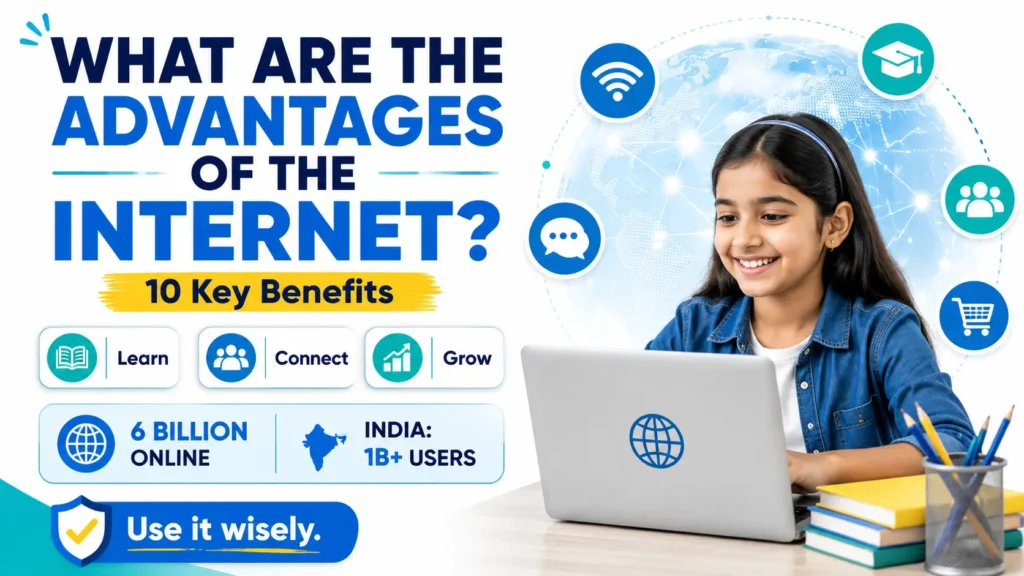
The ten main advantages of the internet are: access to information and education, instant communication across distance, digital payments and financial inclusion, access to government services, employment and remote work, healthcare through telemedicine, market access for small businesses, self-directed skill building, emergency and safety information, and the preservation of languages and culture. These benefits are real but unevenly shared: as of March 2026, India had around 76.59 internet subscribers per 100 people, but rural areas stood at roughly 48.31 per 100 against about 126.80 in urban areas.
Key Takeaways
- Three-quarters of the world is online. The ITU estimated about 6 billion internet users in 2025, roughly 74% of the global population, with 2.2 billion still offline.
- India crossed a billion subscribers. TRAI recorded 1,092.79 million internet subscribers at the end of March 2026, up 6.24% in a single quarter.
- The rural gap is the real story. India’s national figure of 76.59 subscribers per 100 people splits into roughly 126.80 in urban areas and 48.31 in rural areas.
- Access is not the same as benefit. The ITU notes most users have basic digital skills, while advanced abilities like online safety and problem-solving are developing far more slowly.
- Affordability still blocks people. Mobile broadband remains unaffordable in around 60% of low- and middle-income countries.
- Young people are the most connected group. The ITU reports 82% of 15–24-year-olds use the internet, against 72% of everyone else.
- The disadvantages ride along. Misinformation, privacy loss, scams and attention costs come with the same connection, which is why digital literacy matters as much as access.
What This Article Covers
- What Is the Internet, and Why the Question Matters Now
- 10 Advantages of the Internet
- The Advantages Are Not Evenly Shared
- Advantages of the Internet for Students
- The Disadvantages Worth Knowing
- How to Get the Advantages Without the Costs
- How Trinity International School Mysore Approaches Internet Use
- Frequently Asked Questions
Ask what the advantages of the internet are and most answers arrive in the same shape: information, communication, entertainment, shopping. All true, all so obvious that the list stops being useful.
The more interesting question is what the internet actually changed. Before it, how much you could learn was limited by the library nearest you. Who you could reach was limited by who lived within travelling distance. The market you could sell into was limited by the road outside your shop. Every one of those ceilings has moved, and in India that shift happened faster and more recently than in most places.
As of March 2026, India had crossed 1.09 billion internet subscribers. Two decades ago the figure was in the single-digit millions.
This article lists ten advantages with concrete examples rather than abstractions, then covers the part most lists skip, who actually receives these advantages, and what comes attached to them.
What Is the Internet, and Why the Question Matters Now
The internet is a global network of connected computers that exchange information using shared protocols. That definition is accurate and tells you almost nothing about why it matters.
What matters is what the network removed: distance as a barrier to information, to communication and to transactions. A student in a small town can read the same material a student in a capital city reads. A shopkeeper can accept payment from a customer carrying no cash. A patient can consult a specialist who has never visited their district.
The scale is worth stating plainly. The International Telecommunication Union estimated around 6 billion people, roughly three-quarters of the world’s population, were using the internet in 2025, with 2.2 billion still offline. It is among the fastest adoptions of any technology in history, and the consequences are still being worked out.
10 Advantages of the Internet
Each with a concrete example rather than a general claim.
1. Access to information and education
The largest advantage by some distance. National platforms now carry curriculum-aligned material in multiple Indian languages, and open courseware from major universities is available to anyone with a connection. A student preparing for board exams in a town with no coaching centres has access to explanations that did not exist for the previous generation.
2. Communication across any distance
Video calls and messaging removed both cost and delay from staying in touch. For families separated by migration for work, a very large group in India, this changed daily life rather than merely making it more convenient. A parent working in another state attends a child’s birthday instead of hearing about it a week later.
3. Digital payments and financial inclusion
India’s digital payment infrastructure lets a vegetable seller accept money without a card machine and a customer pay without cash. For people previously outside the formal banking system, a phone became the account. This is one of the clearest cases where the internet delivered most to those who had least.
4. Access to government services
Applications, certificates, records and welfare payments that once meant a day of travel and a queue can be handled online, and documents can be stored and retrieved digitally. The advantage is not novelty: it is the removal of travel cost, waiting time, and the discretion of whoever was sitting behind the counter.
5. Employment and remote work
Job listings, applications and in many fields the work itself moved online. This widened both who can be hired for a role and where they can live while doing it. For skilled workers outside major cities, it opened access to employers who would never have advertised locally.
6. Healthcare and telemedicine
Remote consultation lets patients reach specialists who are concentrated in large cities, and test reports move electronically. Health information, used alongside a doctor rather than instead of one, helps people recognise when something needs attention. In districts with few specialists, this is a substantial gain.
7. Market access for small businesses
A weaver, a food producer or a small manufacturer can sell beyond the customers who walk past. Online marketplaces and social platforms give a business with no advertising budget a route to buyers in other states and countries. The shop’s location stopped being the limit on the shop’s market.
8. Self-directed skill building
Anyone can learn to code, repair a motorcycle, use a spreadsheet or speak a new language without enrolling anywhere. Certification still matters for employment, but the knowledge itself is no longer gated. For adults who could not complete formal education, this is a second route in.
9. Emergency and safety information
Weather warnings, disaster alerts, public health advisories and emergency numbers reach people directly and quickly. During floods, cyclones and public health events, how fast a warning travels determines how many people act on it in time.
10. Preservation of language and culture
Regional languages, music, oral histories and local knowledge are being recorded, archived and shared online. Kannada material that once existed only in print or in memory is now searchable and reachable. For smaller languages especially, the internet has become a preservation mechanism rather than a threat.
The Advantages Are Not Evenly Shared
This is the section most lists of ten advantages of the internet leave out, and it changes how the rest should be read.
According to TRAI’s performance indicators for the quarter ending March 2026, India had 1,092.79 million internet subscribers, 651.93 million urban and 440.87 million rural. Expressed per 100 people that is 126.80 in urban areas against 48.31 in rural areas, with a national figure of 76.59.
The global pattern matches. The ITU reports that 85% of people in urban areas worldwide are online against 58% in rural areas, that 96% of those still offline live in low- and middle-income countries, and that mobile broadband remains unaffordable in around 60% of those countries.
A skills gap sits on top of the access gap. The ITU notes that while most internet users have basic skills, more advanced capabilities: online safety, problem-solving, creating digital content, are developing much more slowly. Two people with identical connections can extract completely different value from them.
The honest summary: the advantages listed above are available, not distributed. Access is the first condition and skill is the second, and public discussion tends to attend only to the first.
Advantages of the Internet for Students
Narrowed to school students, four advantages do most of the work.
- Explanations on demand. A concept that did not land in class can be revisited at home as many times as needed, without asking a teacher to repeat it in front of thirty people.
- Visualising the invisible. Simulations show orbital motion, chemical reactions and circuit behaviour in ways a textbook diagram cannot.
- Learning in the language they think in. Material in Kannada and Hindi alongside English removes a barrier for students who understand the concept but not the medium.
- Exposure beyond the local. Students encounter careers, institutions and possibilities that nobody in their immediate circle has followed.
One caution attached to all four: research on reading comprehension consistently finds that study material is understood better on paper than on screen, particularly for informational text and under time pressure. Use the internet to find and understand material, then revise from paper.
The Disadvantages Worth Knowing
A list of advantages that ignores the costs is marketing, not information. Four arrive with the same connection.
| The cost | What it looks like |
|---|---|
| Misinformation | False health claims, edited images and fabricated quotes spread faster than corrections, and are hardest to spot where the reader has no prior knowledge of the subject. |
| Privacy loss | Personal data is collected continuously by services whose terms almost nobody reads, including services used by children. |
| Fraud and scams | Digital payments brought a matching rise in payment fraud, often aimed at people newest to the system and least equipped to recognise it. |
| Attention and wellbeing | Platforms built to hold attention compete directly with sleep, study and in-person relationships, particularly for adolescents. |
None of these is an argument for staying offline. They are an argument for the skills half of the equation, which is exactly the half the ITU data shows is lagging.
How to Get the Advantages Without the Costs
Six habits that separate people who benefit from a connection from people who merely have one.
1. Check who is telling you. Before believing a claim, look at the source. A government site, a university, a named journalist and an anonymous forwarded message are not equivalent.
2. Treat forwarded messages as unverified by default. Anything that arrives already shared many times has passed through many hands and no editors.
3. Protect the account before the device. Strong distinct passwords and two-factor authentication prevent more harm than any antivirus software.
4. Assume anything posted is permanent. Deleting removes something from view, not from existence. This matters most for students, whose posts outlive the mood that produced them.
5. Never act on urgency in a message. Almost every payment scam works by creating time pressure. A genuine bank or government office does not need a decision in ninety seconds.
6. Decide what the session is for before opening it. The difference between using the internet and being used by it is usually whether there was a purpose before the screen unlocked.
How Trinity International School Mysore Approaches Internet Use
Our view is that access without skill produces very little, so we teach both.
Digital literacy at Trinity covers source evaluation, online safety, privacy and responsible use as part of regular teaching rather than as an annual assembly. In lessons we use the internet where it does something a textbook cannot: simulations, visual explanations, material in more than one language, and keep study and revision on paper, because the research on comprehension supports that split.
We also do not assume every family has reliable internet at home. Homework that requires a connection quietly penalises the households least able to say so, and we design around that rather than through it.
Frequently Asked Questions
What are advantages of the internet?
The main advantages are access to information and education, instant communication across distance, digital payments and financial inclusion, online government services, employment and remote work, telemedicine, market access for small businesses, self-directed skill building, emergency information, and the preservation of language and culture.
What are 10 advantages of the internet for students?
Explanations available on demand, simulations that show what textbooks cannot, material in the student’s own language, exposure to careers beyond their locality, free curriculum-aligned content, collaboration on shared documents, accessibility tools such as text-to-speech, access to libraries and archives, skill building beyond the syllabus, and contact with teachers and peers outside class hours.
How many people use the internet in India?
TRAI recorded 1,092.79 million internet subscribers at the end of March 2026, 651.93 million urban and 440.87 million rural, a 6.24% increase over the previous quarter.
Is internet access equal across India?
No. India’s national figure of about 76.59 internet subscribers per 100 people splits into roughly 126.80 per 100 in urban areas and 48.31 per 100 in rural areas, so rural access remains far behind.
How many people use the internet worldwide?
The ITU estimated around 6 billion internet users in 2025, about 74% of the world’s population, with 2.2 billion people still offline, most of them in low- and middle-income countries.
What are the disadvantages of the internet?
Misinformation, loss of privacy, online fraud and scams, and the cost to attention, sleep and in-person relationships. These arrive with the same connection as the benefits, which is why digital literacy matters as much as access.
Is the internet good or bad for children?
Both, depending on skill and supervision. It provides genuine educational access, but children also need explicit teaching in source evaluation, privacy and online safety, along with household rules on screen time, particularly overnight device use.
Conclusion
The advantages of the internet are genuine and large. It removed distance as a limit on what a person could learn, who they could reach and what market they could sell into, and it did so within a single generation.
But a connection is a tool, and tools produce different results in different hands. The data makes this plain: access is spreading faster than the skills needed to use it well, and the gap between urban and rural access in India is still wide enough that the benefits above remain out of reach for a great many people.
Which points to where the effort belongs. Extending access matters. Teaching people, students first, how to evaluate a source, protect an account and use a connection deliberately matters just as much, and is more often left undone.
Access matters. Knowing how to use it matters more.
Trinity International School Mysore teaches digital literacy, source evaluation, online safety and responsible use, as part of regular classroom learning rather than as a one-off talk.
Visit our campus in Mysuru, or book a school tour to see how we use technology in lessons.
Call us at [phone number] | Write to us at [email]
Sources
- International Telecommunication Union, Measuring Digital Development: Facts and Figures 2025: https://www.itu.int/itu-d/reports/statistics/facts-figures-2025/
- ITU, Internet use statistics, Facts and Figures 2025: https://www.itu.int/itu-d/reports/statistics/2025/10/15/ff25-internet-use/
- Telecom Regulatory Authority of India, Indian Telecom Services Performance Indicators: https://www.trai.gov.in
- Ministry of Education, Government of India, DIKSHA national platform for school education: https://diksha.gov.in
- Delgado, P. et al. (2018), Don’t throw away your printed books: a meta-analysis on reading media and comprehension, Educational Research Review: https://www.sciencedirect.com/science/article/pii/S1747938X18300101
About the Author
Dr Shama E Milton
Principal, Trinity Institutions, Mysuru
Dr Shama E Milton leads Trinity Institutions, Mysuru, overseeing academic direction and classroom practice across the group’s schools and colleges. She works with teachers on digital literacy, technology in teaching and NEP 2020 implementation, and writes on how schools can give students the benefits of digital access alongside the skills to use it safely.