Last Updated: October 20, 2026 | Reading time: 10 minutes | By Dr Shama E Milton
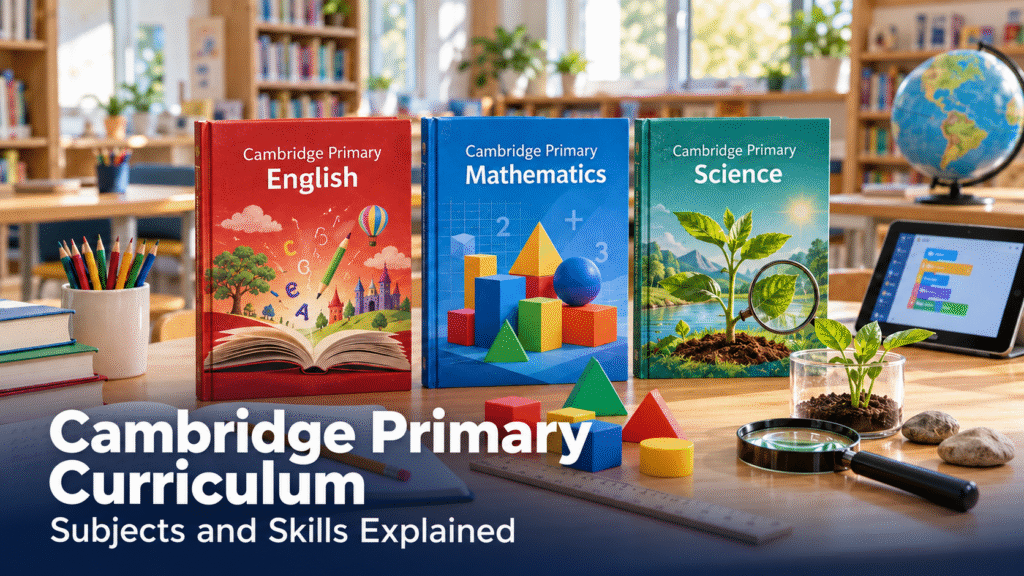
The Cambridge Primary curriculum subjects are English (or English as a Second Language), Mathematics and Science as the core, plus optional subjects including Global Perspectives, Computing, Digital Literacy, Art & Design, Music, Physical Education, Wellbeing and Humanities. Children aged 5 to 11 study them across six stages, with progress measured by Progression Tests and Primary Checkpoint.
Key Takeaways
- Six stages, ages 5 to 11. Cambridge Primary is organised into Stages 1 to 6, each with clear learning objectives.
- Three core subjects. English, Mathematics and Science carry the formal Cambridge assessments.
- A wide optional menu. Cambridge’s parent guide lists 11 subjects to choose from, and its help centre also lists Humanities.
- Schools choose the mix. No school has to teach every subject, so the timetable varies from school to school.
- Two kinds of tests. Progression Tests are marked in school; Primary Checkpoint is marked by Cambridge at the end of Stage 6.
Table of Contents
- What Is Cambridge Primary?
- The Full List of Cambridge Primary Subjects
- Core Subject 1: English
- Core Subject 2: Mathematics
- Core Subject 3: Science
- The Optional Subjects and What They Add
- How the Six Stages Build on Each Other
- How Progress Is Assessed
- How Parents Can Support Each Subject at Home
- Cambridge Primary at Trinity International School Mysore
- Frequently Asked Questions
When parents first look at a Cambridge Primary timetable, two things stand out. The subject names look familiar, but the way each subject is described is not. “Thinking and working scientifically” sounds very different from “Science chapter 4”.
That difference is the point. Cambridge Primary defines what children should know and be able to do in each subject, at each stage, and leaves teachers room to decide how to get there.
This guide lists every Cambridge Primary subject, explains the skills each one builds, shows how the six stages work, and covers how your child’s progress is measured. For an overview of the whole programme from Early Years upward, see our parent’s guide to Cambridge Primary and Early Years.
What Is Cambridge Primary?
Cambridge Primary is the stage of the Cambridge Pathway designed for children aged 5 to 11. It sets learning objectives for each subject across six stages, encourages an inquiry-based approach, and prepares children for Cambridge Lower Secondary or other education systems.
Each stage roughly matches a school year. Stage 1 is usually for children aged 5 to 6, and Stage 6 for children aged 10 to 11. Schools in India often map these to Class 1 through Class 6, though the exact match depends on the school’s year structure.
The Full List of Cambridge Primary Subjects
Cambridge Primary has three core subjects and a set of optional ones. Cambridge’s 2023 guide for parents lists 11 subjects to choose from, and its help centre now also lists Humanities. Schools decide which optional subjects to offer, so the final timetable differs between schools.
| Subject | Core or optional | Main skills it builds |
|---|---|---|
| English | Core | Reading, writing, speaking and listening for real purposes |
| English as a Second Language | Core alternative | Language confidence for children new to English |
| Mathematics | Core | Number, geometry, measure, statistics, reasoning |
| Science | Core | Investigation, prediction, observation, explanation |
| Cambridge Global Perspectives | Optional | Research, analysis, evaluation, reflection, collaboration, communication |
| Computing | Optional | Computational thinking, programming basics, how computers work |
| Digital Literacy | Optional | Safe, responsible and effective use of technology |
| Art & Design | Optional | Creativity, observation, experimenting with materials |
| Music | Optional | Listening, performing, composing |
| Physical Education | Optional | Movement, coordination, teamwork, healthy habits |
| Wellbeing | Optional | Understanding emotions, relationships, self-care |
| Humanities | Optional | History, geography and how communities work |
Core Subject 1: English
Cambridge Primary English develops reading, writing, speaking and listening as connected skills. Children read a range of fiction, non-fiction and poetry, write for different purposes, and practise explaining their ideas aloud. The aim is confident, accurate communication, not just correct grammar exercises.
By Stage 6, a child is expected to write an organised piece for a clear purpose, such as a persuasive letter or an explanation of a process, and to discuss a text with evidence from it.
Children who are still building English confidence can follow Cambridge Primary English as a Second Language instead. Reading at home makes a large difference here; our age-wise guide to the best books for students is a good place to start.
Core Subject 2: Mathematics
Cambridge Primary Mathematics covers number, geometry and measure, and statistics and probability. Alongside these, children practise “thinking and working mathematically”, which means spotting patterns, making conjectures, explaining methods and checking whether an answer makes sense.
This is where many parents see the biggest difference from a rote approach. A child might be asked to find two different ways to solve the same problem, or to explain why a pattern works.
That habit of reasoning is what makes maths useful outside the classroom. Our article on the importance of mathematics in daily life explores why.
Core Subject 3: Science
Cambridge Primary Science covers biology, chemistry, physics, and Earth and space, built around “thinking and working scientifically”. Children learn to ask questions, make predictions, plan fair tests, record observations and explain what their results show.
A Stage 2 child might test which material keeps ice from melting longest. A Stage 5 child might investigate how the length of a pendulum changes its swing. The content matters, but the method of investigating matters just as much.
Science also links naturally to the world outside school. Our explainer on types of food chain is a good example of a topic children meet in primary science.
The Optional Subjects and What They Add
Optional subjects give Cambridge Primary its breadth. They develop creativity, digital skills, physical health and emotional wellbeing, and Global Perspectives in particular trains the thinking skills children use in every other subject. Schools pick the combination that suits their students and timetable.
- Cambridge Global Perspectives focuses entirely on skills, not topic knowledge. Children work on short projects called Challenges about real issues. Read our full guide to Cambridge Global Perspectives.
- Computing introduces how computers work and the basics of programming, often starting with unplugged activities before screens.
- Digital Literacy teaches children to use technology safely and responsibly, and to understand its role in society.
- Art & Design, Music and Physical Education were added to the Cambridge Primary programme in 2019 and build creativity, expression and physical confidence.
- Wellbeing gives curriculum time to emotions, relationships and healthy habits.
- Humanities covers how people, places and communities work.
How the Six Stages Build on Each Other
Each subject’s learning objectives are arranged so that skills grow from Stage 1 to Stage 6. A child meets a concept simply at first, then returns to it with more depth, which Cambridge calls a spiral approach. This helps knowledge stick and reduces gaps when a child moves up.
| Stage | Typical age | What progress looks like in Mathematics |
|---|---|---|
| Stage 1 | 5 to 6 | Counting, comparing and adding small numbers |
| Stage 2 | 6 to 7 | Place value to 100, simple multiplication as repeated addition |
| Stage 3 | 7 to 8 | Numbers to 1,000, fractions as parts of a whole |
| Stage 4 | 8 to 9 | Multiplication facts, decimals in context, area |
| Stage 5 | 9 to 10 | Larger numbers, fractions, decimals and percentages |
| Stage 6 | 10 to 11 | Ratio, negative numbers, more complex problem solving |
The examples above are illustrative. Each school’s scheme of work sets the precise sequence.
How Progress Is Assessed
Cambridge Primary uses two main assessments. Cambridge Primary Progression Tests are marked by teachers in school to track progress each year. Cambridge Primary Checkpoint, taken at the end of Stage 6 in English, Mathematics and Science, is marked by Cambridge and gives an international benchmark.
After Checkpoint, a child receives a statement of achievement, and parents receive detailed feedback. The report shows performance against the curriculum, the class, the school and learners worldwide who sat the same series.
Some schools also use Cambridge Primary Insight, an on-screen assessment that helps teachers see a child’s strengths and needs. Day to day, most assessment is ongoing: teachers watch, question and give feedback during lessons.
How Parents Can Support Each Subject at Home
You do not need to teach the curriculum at home. The most useful support is simple: read together daily, talk about how things work, let your child explain their thinking, and treat mistakes as part of learning rather than something to avoid.
- English: Read aloud for 15 minutes, then ask what your child thinks will happen next and why.
- Maths: Use shopping, cooking and travel times for real calculations.
- Science: Ask “what do you think will happen?” before trying something, then talk about the result.
- Global Perspectives: Discuss a news item and ask “who might see this differently?”
- Wellbeing: Name feelings together and talk about what helps.
For more home activities, see our list of critical thinking activities for kids.
Cambridge Primary at Trinity International School Mysore
Trinity International School Mysore offers Cambridge Primary for children aged 5 and above, building strong academic foundations while nurturing independent thinking. Our teachers plan from Cambridge learning objectives and combine them with Indian languages and values.
To see the subjects in action, explore our Primary programme and our clubs and activities beyond academics.
Frequently Asked Questions
What subjects are in the Cambridge Primary curriculum?
The core subjects are English (or English as a Second Language), Mathematics and Science. Optional subjects include Cambridge Global Perspectives, Computing, Digital Literacy, Art & Design, Music, Physical Education, Wellbeing and Humanities. Schools choose which optional subjects to offer.
How many subjects are there in Cambridge Primary?
Cambridge’s guide for parents lists 11 subjects to choose from, and its help centre also lists Humanities as part of the programme. Schools do not have to offer every subject, so the number on a child’s timetable varies.
What are the stages of Cambridge Primary?
Cambridge Primary has six stages, from Stage 1 for children aged about 5 to 6, to Stage 6 for children aged about 10 to 11. Each stage builds on the skills and knowledge of the one before.
What is Cambridge Primary Checkpoint?
Cambridge Primary Checkpoint is a set of tests taken at the end of Stage 6 in English, Mathematics and Science. Cambridge marks them and provides a statement of achievement plus a feedback report comparing the child with learners worldwide.
Are Cambridge Progression Tests compulsory?
Progression Tests are a tool schools can use to track progress each year. They are marked by teachers in school. Whether and when they are used depends on the school, so ask how progress is reported to parents.
Can Indian languages be taught alongside Cambridge Primary?
Yes. Cambridge states that schools can combine Cambridge Primary with local programmes, so Indian languages such as Kannada and Hindi are commonly taught alongside the Cambridge subjects.
Conclusion
The Cambridge Primary curriculum subjects look familiar on paper: English, Maths and Science at the core, with arts, sport, computing and wellbeing around them. What makes them different is how each one is taught. Every subject asks children to think, explain and apply, not just to remember.
Across six stages, those skills build steadily, and Checkpoint at the end gives families an honest international measure of where their child stands.
If you are choosing a primary school, ask to see a lesson in progress. The subject list tells you what children learn. The classroom tells you how.
Explore Cambridge Primary at TISM
Visit Trinity International School Mysore to see Cambridge Primary subjects taught in our classrooms and meet the teachers behind them.
Start on our How to Apply page or get in touch.
Call +91 990151 0055 | Email info@tismysore.com
Sources
- Cambridge International, Cambridge Primary: an introduction for parents: https://www.cambridgeinternational.org/Images/269097-cambridge-primary-an-introduction-for-parents.pdf
- Cambridge International, How does Cambridge Primary reflect local and national content requirements: https://help.cambridgeinternational.org/hc/en-gb/articles/360000050097-How-does-Cambridge-Primary-reflect-local-and-national-content-requirements
- Cambridge International, Cambridge Primary brochure: https://www.cambridgeinternational.org/Images/599345-cambridge-primary-brochure.pdf
- Cambridge International, Introducing the new subjects in Primary and Lower Secondary: https://www.cambridgeinternational.org/Images/557895-20.-introducing-the-new-subjects-in-primary-and-lower-secondary.pdf
About the Author
Dr Shama E Milton
Principal, Trinity Institutions, Mysuru
Dr Shama E Milton leads Trinity Institutions, Mysuru, overseeing academic direction and classroom practice across the group’s schools and colleges. She works closely with teachers on curriculum planning, Cambridge teaching practice and NEP 2020 implementation, and writes for parents on choosing and getting the most from a child’s school years.