Last Updated: October 6, 2026 | Reading time: 12 minutes | By Dr Shama E Milton
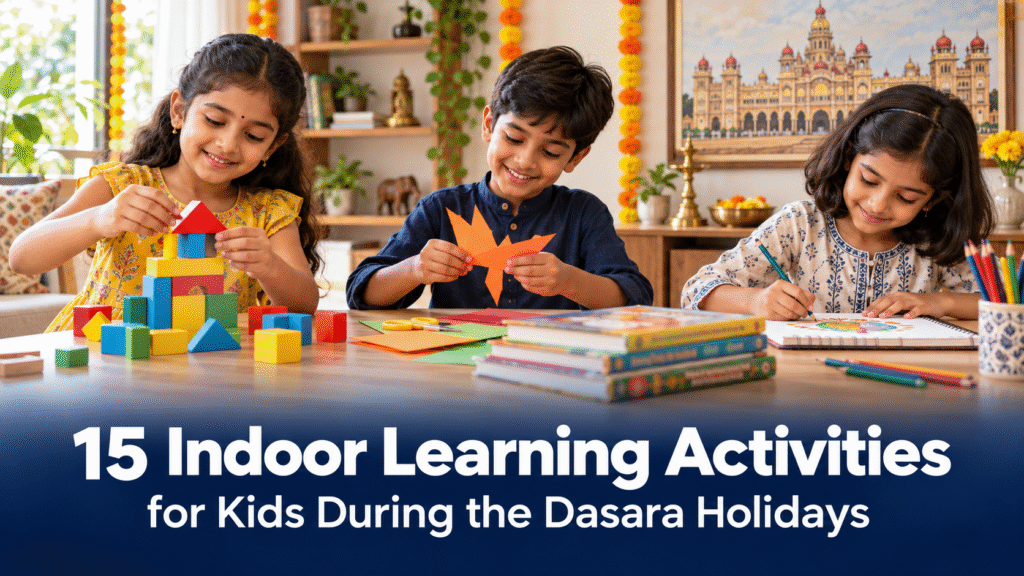
The best indoor learning activities for kids during the Dasara holidays mix festival traditions with real skills: gombe storytelling, a paper Jamboo Savari elephant, kitchen maths, Ali Guli Mane, rangoli symmetry, a reading challenge, simple science experiments and a family show. Each takes 20 to 60 minutes and needs only things you already have at home.
Key Takeaways
- The break is long this year. Karnataka’s academic calendar sets school Dasara holidays from 3 to 21 October 2026, with classes resuming on 22 October.
- Mysuru Dasara runs 11 to 21 October. Indoor activities can fill the quieter days between festival outings.
- Learning works best in short blocks. Twenty to forty-five minutes of focused activity is plenty for primary-age children.
- Tradition is a great teacher. Gombe displays, Ali Guli Mane and rangoli build storytelling, counting and geometry naturally.
- Keep screens in check. The Indian Academy of Pediatrics recommends under two hours of screen time a day for children aged 5 to 10.
Table of Contents
- When Are the Dasara Holidays in 2026?
- All 15 Activities at a Glance
- The 15 Activities in Detail
- How to Balance Activities, Festival Days and Rest
- Learning Through Play at Trinity International School Mysore
- Frequently Asked Questions
The Dasara holidays are one of the best times of the year to be a child in Mysuru. The city lights up, families gather, and there is a festival feel in every street.
There are also long, quiet hours at home. Afternoons that are too hot to go out, evenings after a crowded day, mornings before relatives arrive. Without a plan, those hours often drift to a screen.
This list gives you 15 indoor learning activities for kids that fit naturally into the festival. None needs special equipment. Each one builds a real skill, from counting to storytelling to scientific thinking, and most are fun enough that children will not notice they are learning.
When Are the Dasara Holidays in 2026?
Karnataka’s 2026-27 academic calendar sets the school Dasara holidays from 3 October to 21 October 2026, with schools reopening on 22 October. The official Mysuru Dasara festival runs from 11 to 21 October 2026. Private and international schools may set slightly different dates, so check your own school calendar.
That is close to three weeks at home. It is long enough for a child to lose some school rhythm, and also long enough to try something new. A light routine, with a few activities each day, keeps both sides in balance. Our guide to a daily routine for students during the holidays shows how to plan a balanced day.
All 15 Activities at a Glance
| # | Activity | Best for ages | Time | Main skill |
|---|---|---|---|---|
| 1 | Gombe storytelling corner | 4 to 11 | 30 to 45 min | Storytelling, writing |
| 2 | Paper Jamboo Savari elephant | 4 to 10 | 40 min | Fine motor, measuring |
| 3 | Festival kitchen maths | 5 to 11 | 30 min | Measurement, fractions |
| 4 | Dasara budget shopping game | 6 to 11 | 20 min | Money, addition |
| 5 | Shadow puppet show | 4 to 11 | 45 min | Light, storytelling |
| 6 | Ten-book reading challenge | 5 to 11 | 20 min a day | Reading fluency |
| 7 | Dasara diary | 6 to 11 | 15 min a day | Writing, reflection |
| 8 | Kitchen science experiments | 5 to 11 | 30 min | Prediction, observation |
| 9 | Rangoli symmetry patterns | 5 to 11 | 30 min | Geometry, art |
| 10 | Indoor treasure hunt | 4 to 11 | 30 min | Reading, logic |
| 11 | Ali Guli Mane and Chowka Bhara | 5 to 11 | 20 to 30 min | Counting, strategy |
| 12 | Recycled palace model | 6 to 11 | 60 min | Design, engineering |
| 13 | Word of the day wall | 5 to 11 | 10 min a day | Vocabulary |
| 14 | Seed in a jar | 4 to 11 | 10 min a day | Observation, science |
| 15 | Family festival show | 5 to 11 | 60 min | Speaking, confidence |
The 15 Activities in Detail
Each activity below needs only everyday household items. Pick two or three for a day, adjust them to your child’s age, and let your child choose the order. The point is short, focused, enjoyable learning that fits around festival outings and family visits, not a holiday timetable that feels like school.
1. Gombe Storytelling Corner
Turn your family’s Navaratri gombe (doll) display into a storytelling project. Ask your child to choose five dolls, write a short label for each, and then make up a story that connects them. Younger children can tell the story aloud while you write it down.
This builds sequencing, vocabulary and writing for a real audience. Visitors who come to see the gombe can be given a “tour” by your child, which is also great speaking practice.
2. Paper Jamboo Savari Elephant
Make a paper elephant decorated like the ones in the Jamboo Savari procession. Children trace and cut shapes, measure the ears so they match, and decorate the howdah with patterns. Older children can make it fold to stand up on its own.
Along the way they practise measuring, symmetry and following steps in order. Talk about why the procession uses elephants and what the howdah carries.
3. Festival Kitchen Maths
Choose a simple festival snack and let your child read the recipe and measure the ingredients. Ask them to halve or double the recipe, which turns cooking into a fractions lesson. Keep the stove and knives as an adult-only job.
For kitchen ground rules, see our list of safety rules for children at home.
4. Dasara Budget Shopping Game
Give your child a pretend budget, such as Rs 500, and a list of festival items with prices. They must plan what to buy without going over. Older children can compare two shops or work out the change from a larger note.
This is real-world maths: addition, subtraction and decision-making. It also starts useful conversations about value and choices.
5. Shadow Puppet Show
Cut simple shapes from card, tape them to sticks, and use a torch against a wall to create a shadow puppet show. Children can retell a festival story or invent their own. Ask them to notice what happens to a shadow when the puppet moves closer to the light.
They are learning about light and shadows in science, and planning a story with a beginning, middle and end.
6. Ten-Book Reading Challenge
Set a goal of ten books over the holidays and create a simple reading log with the title, date and one sentence about each book. Twenty minutes a day is enough. Picture books count for younger readers.
Reading is the single habit most closely linked with school success. Our guides on why reading is a good habit and the best books for students by age will help you pick titles.
7. Dasara Diary
Give your child a notebook to record one thing each day: a place they visited, a food they tried or a moment they enjoyed. Add a drawing or a ticket stub. Younger children can draw and dictate a sentence.
A diary builds writing stamina and reflection. By the end of the break, your child also has a keepsake of the festival.
8. Kitchen Science Experiments
Simple experiments with kitchen items teach children to predict, test and observe. Try which items sink or float in water, how fast sugar dissolves in hot and cold water, or what happens when baking soda meets lemon juice. Always ask “what do you think will happen?” first.
That one question is the heart of scientific thinking. Writing down the prediction and the result turns play into a real investigation.
9. Rangoli Symmetry Patterns
Draw rangoli designs on paper using a dot grid, then colour them in. Challenge your child to make a design that is the same on both sides, or that repeats four times around a centre point. Older children can measure angles.
Rangoli is a beautiful way to teach symmetry, patterns and shapes, which are key ideas in primary geometry.
10. Indoor Treasure Hunt
Hide a small treat and write five or six clues that lead to it, each clue pointing to the next hiding place. For younger children use pictures; for older children use riddles or simple maths problems.
Children practise reading carefully and reasoning step by step. Once they understand how it works, let them write clues for you.
11. Ali Guli Mane and Chowka Bhara
Bring out traditional Karnataka board games. Ali Guli Mane, played with seeds or shells on a wooden board, involves constant counting and planning. Chowka Bhara, a race game using cowrie shells as dice, teaches strategy and turn-taking.
These games are a gentle way to practise mental maths, and a good chance for grandparents to teach a game they played as children.
12. Recycled Palace Model
Use cardboard boxes, bottle caps and paper tubes to build a model of the Mysuru Palace or any building your child admires. Plan it on paper first, then build. Add fairy lights for the Dasara illumination effect if you have them.
This is design and engineering thinking: planning, testing what stands up, and fixing what does not.
13. Word of the Day Wall
Stick a sheet of paper on a wall and add one new word each day, in English, Kannada or Hindi. Your child writes the word, its meaning and a sentence using it. By the end of the break, the wall has close to 20 words.
Small, daily vocabulary building is easy to keep up and makes a noticeable difference to reading and writing.
14. Seed in a Jar
Place a few bean or methi seeds on damp cotton or tissue in a glass jar and watch them sprout. Your child measures and draws the growth every day, noticing roots, shoots and leaves.
This builds patience and careful observation. Our article on the importance of planting is a good follow-up read for older children.
15. Family Festival Show
End the holidays with a family show. Your child plans the programme, which might include a song, a poem, a short play or a magic trick, then presents it to the family. Older children can write invitations and a printed programme.
Speaking in front of others builds confidence and communication, two skills that matter in every classroom.
How to Balance Activities, Festival Days and Rest
Plan one or two short learning activities a day, leave festival days free, and protect sleep and outdoor time. The goal is a gentle rhythm, not a second school timetable. Children who keep a light routine settle back into school far more easily on 22 October.
A few practical tips:
- Mix types. Pair a quiet activity, like reading, with an active one, like the treasure hunt.
- Let your child choose. Offer three options and let them pick. Choice builds motivation.
- Watch screen time. The Indian Academy of Pediatrics recommends no more than one hour of supervised screen time a day for children aged 2 to 5, and less than two hours for children aged 5 to 10.
- Rest is not wasted time. Boredom often leads to the most creative play.
For more on screen habits, see our article on the harmful effects of mobile phones on students.
Learning Through Play at Trinity International School Mysore
At Trinity International School Mysore, our Cambridge Early Years and Primary programmes are built on the idea that children learn best when they are curious and actively involved. Many of the activities above, from investigations to storytelling, reflect how learning happens in our classrooms.
See more of school life in TISM Moments, or explore our Early Years programme.
Frequently Asked Questions
What are some indoor learning activities for kids?
Good indoor learning activities include storytelling projects, simple kitchen science experiments, measuring ingredients for a recipe, rangoli symmetry patterns, reading challenges, treasure hunts with clues, traditional board games like Ali Guli Mane, and building models from recycled materials.
When are the Dasara holidays for schools in Karnataka in 2026?
Karnataka’s 2026-27 academic calendar sets school Dasara holidays from 3 October to 21 October 2026, with schools reopening on 22 October. Private and international schools may follow slightly different dates, so check your school calendar.
How long should children study during the holidays?
There is no fixed rule, but one or two short learning activities of 20 to 45 minutes a day are enough for most primary-age children. The aim is to keep a gentle rhythm, not to replicate a full school day.
What educational activities can I do with my child during Dasara?
Use festival traditions as learning tools: turn the gombe display into a storytelling project, make a Jamboo Savari elephant craft, practise maths with festival cooking or a shopping budget, and keep a Dasara diary of places visited.
How much screen time is okay during the holidays?
The Indian Academy of Pediatrics recommends no screens for children under 2, a maximum of one hour of supervised screen time a day for children aged 2 to 5, and less than two hours a day for children aged 5 to 10.
How can I make learning fun for kids at home?
Let children choose between activities, connect learning to real things like cooking, shopping and festivals, keep sessions short, and ask open questions like “what do you think will happen?” Play-based activities often teach more than worksheets.
Conclusion
The Dasara holidays give children something school days cannot: long, open time with family, surrounded by tradition. With a little planning, that time can also be full of learning.
Pick a few activities from this list, let your child choose the order, and keep it light. A story told around the gombe, a game of Ali Guli Mane with a grandparent, or a seed sprouting on the windowsill may be the moments your child remembers most.
Happy Dasara from all of us at Trinity International School Mysore.
Explore TISM After the Holidays
Looking for a school that values curiosity and learning through doing? Visit Trinity International School Mysore after the festival break to see our Cambridge Early Years and Primary classrooms.
Plan your visit on our How to Apply page or contact us.
Call +91 990151 0055 | Email info@tismysore.com
Sources
- News Karnataka, Karnataka schools to get 19-day Dasara holiday from October 3 (September 2026): https://newskarnataka.com/bengaluru/karnataka-schools-to-get-19-day-dasara-holiday-from-october-3/21092026/
- Indian Academy of Pediatrics, Guidelines on Screen Time and Digital Wellness in Infants, Children and Adolescents, Indian Pediatrics (2022): https://www.indianpediatrics.net/mar2022/235.pdf
About the Author
Dr Shama E Milton
Principal, Trinity Institutions, Mysuru
Dr Shama E Milton leads Trinity Institutions, Mysuru, overseeing academic direction and classroom practice across the group’s schools and colleges. She works closely with teachers on early years and primary learning, and writes for parents on simple ways to support children’s learning at home.