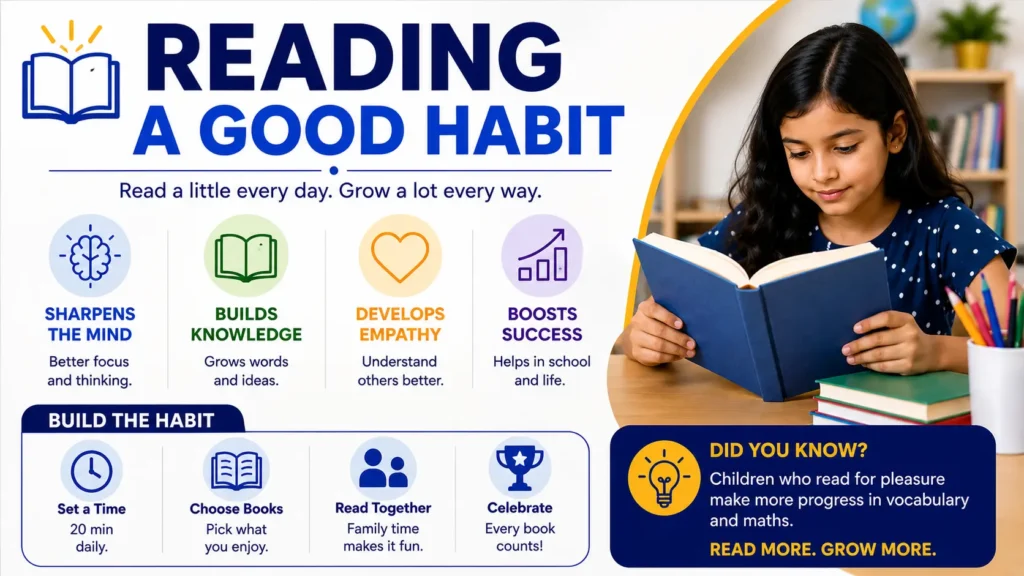
Reading is a good habit because it produces measurable gains in vocabulary, comprehension and even mathematics, and because it compounds, every book makes the next one easier. Research following around 6,000 people found that children who read for pleasure made more cognitive progress between ages 10 and 16 than those who rarely read, with an effect larger than that of having a graduate parent. Building the habit takes longer than most families expect: habit-formation research suggests a median of around 66 days of daily repetition, with wide variation. Twenty minutes a day, at the same time, with a book the child chose, is the method that works.
Key Takeaways
- The academic return is documented. Children who read for pleasure made more progress in vocabulary, spelling and mathematics between ages 10 and 16 than children who rarely read.
- It outweighs family advantage. In the same research, reading books often, using a library and reading newspapers at 16 had roughly four times the effect of having a parent with a degree.
- Habits take longer than 21 days. A UCL study found a median of about 66 days to reach automatic behaviour, ranging from 18 to 254 days depending on the person and the task.
- Missing one day does not break it. The same study found a single missed day had no meaningful effect on habit formation, which is worth telling a discouraged child.
- Paper beats screen for study reading. A meta-analysis of 54 studies and over 170,000 participants found better comprehension on paper than on screen, mainly for informational texts rather than stories.
- “Digital natives” are not exempt. That screen effect grew stronger over the years studied rather than shrinking, so growing up with devices does not remove it.
- Consistency beats volume. Twenty minutes at the same time daily builds the habit faster than two long weekend sessions.
What This Article Covers
- Why Reading Is a Good Habit
- What the Research Actually Shows
- How Long the Reading Habit Takes to Build
- Paper or Screen: Does the Format Matter?
- How to Build the Good Habit of Reading at Home
- Why Reading Habits Break, and How to Restart
- Reading in More Than One Language
- How Trinity International School Mysore Builds the Reading Habit
- Frequently Asked Questions
“Reading is a good habit” is one of those statements everyone agrees with and almost nobody acts on.
It appears in school assemblies, on classroom walls, and in essays children write and then forget. What it rarely comes with is a method: how many minutes, at what time, with which book, and what to do in week three when the child says they are bored.
That gap matters, because the evidence behind the slogan is unusually strong. Reading for pleasure has a measurable effect on academic progress that holds even after accounting for family background. It is one of the few things a parent can do at home that reliably moves the needle.
This article covers what the research actually shows, how long the habit realistically takes to form, whether paper or screen makes a difference, and a seven-step method for building it. For which books to choose at each age, see our separate age-wise reading guide.
Why Reading Is a Good Habit
Most lists of benefits are vague. These are the four that hold up.
It compounds. Vocabulary acquired from one book makes the next book easier, which makes reading faster, which makes more reading likely. Few school activities have this property. Most give a fixed return; reading gives an increasing one.
It transfers across subjects. A student who reads well absorbs a science chapter faster, understands a word problem in mathematics more accurately, and writes a clearer history answer. Reading ability is the input to almost every subject on the timetable.
It builds sustained attention. Finishing a two-hundred-page book requires holding a thread across days. That capacity is increasingly rare and increasingly valuable, and there are few other ordinary activities that train it.
It develops perspective. Spending hours inside another person’s thinking is a form of practice at understanding people unlike yourself, something children get very little of otherwise.
Notice what is not on this list: relaxation, imagination, general knowledge. Those are real, but they are also true of films and conversation. The four above are what make the good habit of reading specifically worth protecting.
What the Research Actually Shows
The clearest evidence comes from a study by Dr Alice Sullivan and Matt Brown at the Institute of Education, which followed around 6,000 people in the 1970 British Cohort Study and tested them at ages 5, 10 and 16.
Children who read for pleasure made more progress in vocabulary, spelling and mathematics between ages 10 and 16 than children who rarely read. The mathematics result surprised the researchers themselves; the likely explanation is that strong readers absorb new information more efficiently in every subject, including numerical ones.
The comparative finding is the striking one. Reading for pleasure was more strongly linked to cognitive progress in adolescence than the parents’ own level of education. The combined effect of reading books often, going to the library regularly and reading newspapers at 16 was roughly four times greater than the advantage of having a graduate parent.
This is worth stating plainly to families who feel their own education limits what they can offer their children. It does not. A house where reading happens does more than a house where degrees hang on the wall.
How Long the Reading Habit Takes to Build
The popular claim is 21 days. It is wrong, and believing it is one of the more common reasons families give up.
A study by Phillippa Lally and colleagues at University College London tracked 96 volunteers building a new daily behaviour over 12 weeks. The median time to reach automatic behaviour was about 66 days, and the range ran from 18 days to a projected 254 days depending on the person and the complexity of the task.
Two practical consequences follow.
- Plan for two to three months, not three weeks. A reading habit that feels effortful in week four is on schedule, not failing.
- One missed day is not a broken habit. The study found that missing a single day did not derail the process. Tell a child this directly, many treat one skipped evening as proof they are not a reader.
Consistency of context matters more than duration. The same twenty minutes, in the same place, at the same point in the evening, builds automaticity faster than the same total time scattered unpredictably across a week.
Paper or Screen: Does the Format Matter?
For study reading, yes, more than most people assume.
A meta-analysis by Pablo Delgado and colleagues, covering 54 studies and more than 170,000 participants between 2000 and 2017, found that reading on paper produced better comprehension than reading the same text on screen. The effect was modest in statistical terms but meaningful in an educational context, given how much a primary student’s comprehension typically improves in a single school year.
Three details are worth knowing:
- It applies mainly to informational texts. For narrative and story reading, the difference largely disappears. So a novel on a tablet is fine; a chapter of science revision is better on paper.
- It is worse under time pressure. When reading time was limited, the advantage of paper grew, which makes exam revision the worst possible case for screen reading.
- Growing up digital does not help. The effect strengthened across the years studied rather than fading, so younger “digital native” readers show no immunity to it.
The practical rule for a household: stories in any format the child prefers, study material on paper.
How to Build the Good Habit of Reading at Home
Seven steps, in order. The first three matter most.
1. Fix the time, not the amount. Pick a slot that already exists, after dinner, before lights out, and attach reading to it. Habit research is clear that a stable context does more than willpower.
2. Start at twenty minutes. Long enough to get past the first few pages, short enough that no one negotiates. If twenty is a fight, start at ten and stop making it a fight.
3. Let the child choose the book. Choice is the mechanism that sustains the habit. A book they picked and half-enjoy beats a better book they resent.
4. Remove the phone from the room. Not as punishment, as design. Twenty minutes of reading beside a silent phone is not twenty minutes of reading.
5. Read alongside them. Adults reading in the same room does more than any instruction to read. It also makes the twenty minutes feel like a shared activity rather than a chore assigned to children.
6. Keep books visible and within reach. A shelf in the living room gets used; a cupboard in a bedroom does not. Friction decides more behaviour than motivation does.
7. Track weeks, not pages. Counting pages turns reading into a target. Marking off days on a calendar builds the sense of a streak, which is what habit formation actually rewards.
Why Reading Habits Break, and How to Restart
Reading habits rarely end dramatically. They erode. The four common causes, and the fix for each:
| What went wrong | What to do |
|---|---|
| The book was too hard | Drop down a level without comment. A book that is slightly too easy rebuilds momentum faster than one that is correctly pitched. |
| Exams took over the slot | Halve the time rather than cancelling it. Ten minutes preserves the habit; zero minutes ends it. |
| The phone came back into the room | Reset the physical rule for everyone in the house, adults included. Selective rules do not survive adolescence. |
| It became a performance | Stop asking what they read and what they learned. Reading that is checked stops being reading for pleasure. |
To restart after a long gap, do not resume where the habit stopped. Begin again at ten minutes with a book the child is confident they will enjoy, and build back. Restarting is easier than starting, but only if the first week is easy.
Reading in More Than One Language
In Karnataka, many students read more fluently in Kannada than in English, or move between Kannada, Hindi and English across the day. Families sometimes treat reading in the mother tongue as less valuable. It is not.
Reading skill transfers between languages. A child who reads fluently in Kannada is building comprehension, inference and vocabulary strategies that carry into English reading. Insisting on English-only reading with a child who finds English effortful usually produces less reading in both languages, not more in one.
This is also the principle behind the Ministry of Education’s Padhe Bharat reading campaign, which was built around making age-appropriate books available in mother tongue and regional languages, and behind NEP 2020’s emphasis on multilingual reading material. The goal at the start is volume and enjoyment. Language balance can be adjusted later.
How Trinity International School Mysore Builds the Reading Habit
A school can create the conditions; a home creates the habit. Both are needed, and they need to say the same thing.
At Trinity, library time is part of the weekly timetable rather than an occasional visit, and students choose their own books rather than reading from a fixed assigned list. Our teachers read aloud to younger classes well past the age at which children can read independently, because listening comprehension runs ahead of reading ability for years. We stock Kannada and Hindi titles alongside English, so students who read more fluently in their mother tongue are not excluded from the pleasure of a story.
What we ask of parents is one thing: twenty protected minutes a day, screens out of the room. Over a school year it is the strongest single predictor of how much a child’s reading improves, and it costs nothing.
Frequently Asked Questions
Why is reading a good habit?
Because it compounds and transfers. Vocabulary from one book makes the next easier, and stronger reading improves performance across every subject, not only languages. It also builds sustained attention, which few other everyday activities train.
Does reading actually improve academic results?
Yes. Research following around 6,000 people found that children who read for pleasure made more progress in vocabulary, spelling and mathematics between ages 10 and 16 than those who rarely read, with an effect on cognitive progress larger than that of parental education.
How long does it take to build a reading habit?
Longer than the popular 21-day claim. A University College London study found a median of about 66 days to reach automatic behaviour, with a range from 18 to 254 days. Plan for two to three months of daily repetition.
Does missing a day ruin the habit?
No. The same study found that missing a single day had no meaningful effect on habit formation. Worth telling children directly, since many treat one skipped evening as proof they cannot sustain it.
Is reading on a screen as good as reading on paper?
For stories, largely yes. For study and informational texts, no, a meta-analysis of 54 studies and over 170,000 participants found better comprehension on paper, with the gap widening when reading time is limited.
How many minutes a day should a student read?
Twenty minutes daily, at a fixed time, with screens out of the room. Consistency of timing matters more than total duration, and a shorter session kept every day beats longer sessions kept occasionally.
Is reading in the mother tongue as useful as reading in English?
Yes, especially at the start. Reading skills transfer between languages, so a child reading fluently in Kannada is building comprehension strategies that carry into English. Volume and enjoyment matter more than language at the habit-building stage.
Conclusion
Reading is a good habit in the same way that sleep and exercise are good habits, everyone knows it, and knowing it changes nothing without a routine attached.
The routine is not complicated. Twenty minutes, the same time each day, a book the child chose, the phone in another room, an adult reading nearby. Expect it to feel effortful for two months. Expect at least one week where nobody feels like it.
What makes it worth the effort is the compounding. A child who reads for twenty minutes a day for a year has read for over a hundred hours, and each of those hours made the next one easier. Very little else a family does at home works that way.
The reading habit is built at school and at home together.
Trinity International School Mysore runs library time as part of the weekly timetable, with student-chosen books and titles in Kannada, Hindi and English.
Visit our campus in Mysuru, or book a school tour to see our library and meet our teachers.
Call us at [phone number] | Write to us at [email]
Sources
- Sullivan, A. and Brown, M. (2015), Reading for pleasure and progress in vocabulary and mathematics, British Educational Research Journal: https://bera-journals.onlinelibrary.wiley.com/doi/abs/10.1002/berj.3180
- UCL Centre for Longitudinal Studies, Reading for pleasure puts children ahead in the classroom: https://cls.ucl.ac.uk/reading-for-pleasure-puts-children-ahead-in-the-classroom-study-finds/
- Lally, P., van Jaarsveld, C., Potts, H. and Wardle, J. (2010), How are habits formed: Modelling habit formation in the real world, European Journal of Social Psychology: https://onlinelibrary.wiley.com/doi/abs/10.1002/ejsp.674
- Delgado, P., Vargas, C., Ackerman, R. and Salmeron, L. (2018), Don’t throw away your printed books: A meta-analysis on the effects of reading media on reading comprehension, Educational Research Review: https://www.sciencedirect.com/science/article/pii/S1747938X18300101
- Press Information Bureau, Government of India, Padhe Bharat 100 Days Reading Campaign: https://www.pib.gov.in/PressReleasePage.aspx?PRID=1786786
- Ministry of Education, Government of India, National Education Policy 2020: https://www.education.gov.in
About the Author
Dr Shama E Milton
Principal, Trinity Institutions, Mysuru
Dr Shama E Milton leads Trinity Institutions, Mysuru, overseeing academic direction and student development across the group’s schools and colleges. She works with teachers and parents on literacy, library practice and multilingual reading in line with NEP 2020, and writes on how families and schools can build reading habits that last beyond school.