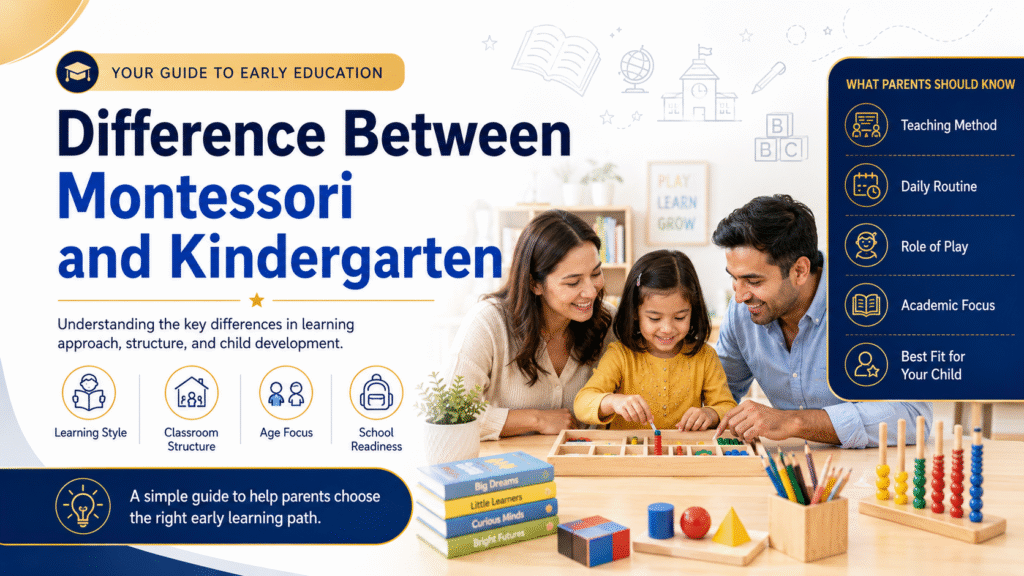
The main difference between Montessori and kindergarten is that Montessori is a teaching method, while kindergarten is a stage of early education. Both usually serve children between the ages of roughly 3 and 6 — which is exactly why parents in Mysore and across India end up comparing them side by side when choosing their child’s very first school.
If you have been researching a preschool in Mysore and feel unsure whether “Montessori” and “kindergarten” mean the same thing, you are not alone. This guide explains the difference between Montessori and kindergarten in plain language: where each idea came from, how the classrooms actually differ, what the two terms mean inside the Indian school system, and how to decide which approach suits your child.
Montessori vs Kindergarten: The Quick Answer
Before the detail, here is the montessori vs kindergarten comparison at a glance. Read this table first, then dig into the sections below for the reasoning behind each point.
| Aspect | Montessori | Kindergarten |
|---|---|---|
| What it is | A teaching method or philosophy | A stage of early schooling (also a Froebelian philosophy) |
| Founder | Dr. Maria Montessori (Italy, 1907) | Friedrich Fröbel (Germany, 1837) |
| Typical age | 2.5–6 years (and beyond in some schools) | 4–6 years (in India, LKG & UKG) |
| Classroom | Mixed-age, often three-year spans | Single age group per class |
| Teacher’s role | Guide and observer (“follow the child”) | Leads and directs group activities |
| Learning style | Self-directed, hands-on, individual pace | Structured, teacher-led, group-paced |
| Materials | Specific self-correcting Montessori apparatus | Varied toys, worksheets, play and craft |
| Structure | Long, uninterrupted “work” periods | Fixed timetable of shorter activities |
In short: you are not really comparing two versions of the same thing. You are comparing a way of teaching (Montessori) with a level of schooling (kindergarten) that can itself be taught in many different styles. Once you see that, the rest becomes much clearer.
What Is Montessori?
Montessori is an educational method developed by Dr. Maria Montessori, an Italian physician and educator who opened her first classroom — the Casa dei Bambini, or “Children’s House” — in a poor district of Rome in 1907. Working with children who had never been to school, she noticed that when they were given carefully designed materials and the freedom to choose their own activities, they concentrated deeply and taught themselves to read, write, and count without being forced.
According to the American Montessori Society, an authentic Montessori programme rests on a few core elements: specially trained Montessori teachers, mixed-age classrooms that usually span three years, hands-on self-correcting materials, child-directed work, and long uninterrupted periods where children work at their own pace. The guiding principle is often described as “freedom within limits” — children choose their work, but inside a prepared, orderly environment.
Key features of a Montessori classroom
- Child-led learning: Children select their own activities and repeat them until mastered, building focus and independence.
- Mixed ages: Younger children learn by watching older ones; older children reinforce their learning by mentoring.
- The teacher as a guide: Rather than lecturing the whole class, the teacher observes each child and introduces the next material at the right moment.
- Purpose-built materials: Tools like number rods, sandpaper letters, and the pink tower make abstract ideas physical and let children spot their own mistakes.
What Is Kindergarten?
Kindergarten is a German word that means “children’s garden.” It was coined by the educator Friedrich Fröbel, who opened the first kindergarten in Germany in 1837. As NAEYC explains, Fröbel chose the “garden” image deliberately: a young child, like a seedling, needs nurturing to grow, and the teacher tends that growth much as a gardener tends a plant.
Fröbel designed kindergarten as a gentle bridge between home and formal school for children aged about four to six, using songs, stories, nature, play, and a famous set of learning toys he called “gifts.” You can read more about his life and ideas in this Britannica profile of Friedrich Fröbel.
Here is the important part for parents today: over time, “kindergarten” shifted from being one man’s specific philosophy to a general stage of schooling. In most modern schools, kindergarten simply refers to the class (or two classes) that children attend before Grade 1 — and the teaching inside it is usually more structured, teacher-led, and grouped by age than a Montessori classroom.
7 Key Differences Between Montessori and Kindergarten
With the definitions in place, here are the practical differences that actually affect your child’s day.
1. Method vs stage
This is the difference everything else flows from. Montessori is a method that can be applied to many ages; kindergarten is a stage that can be taught using many methods — including, confusingly, a Montessori one.
2. Who leads the learning
In Montessori, the child leads and the teacher guides. In a typical kindergarten, the teacher leads a planned activity and the whole class follows along together.
3. Age grouping
Montessori classrooms deliberately mix ages so children learn from one another. Kindergarten classes are usually a single age band, so every child is working on roughly the same thing at the same time.
4. Pace and freedom
Montessori children move through materials at their own speed and can spend a long time on one task. Kindergarten runs on a shared timetable, with activities changing at set times.
5. Materials
Montessori uses a precise, standardised set of self-correcting apparatus. Kindergarten classrooms tend to use a broader mix of toys, worksheets, art, and play equipment.
6. Structure and routine
Montessori protects long, uninterrupted work cycles. Kindergarten offers more routine and predictability, which some children find reassuring.
7. What “success” looks like
Montessori emphasises independence, concentration, and intrinsic motivation. Kindergarten often adds early group readiness — sitting in a class, following instructions, and taking turns — that eases the move into formal Grade 1.
Montessori vs Kindergarten in the Indian Context
In India, the two words are used in a slightly different way, and this trips up many parents. Here, “Montessori” usually describes a teaching method, while “kindergarten” usually describes grade levels — most commonly LKG (Lower Kindergarten) and UKG (Upper Kindergarten) for children aged roughly four to six.
The National Education Policy (NEP) 2020 reshaped how India thinks about these years. It created a single “Foundational Stage” covering ages 3 to 8 — three years of preschool (nursery, LKG, UKG or anganwadi) followed by Grades 1 and 2 — and asked schools to make learning play-based, activity-driven, and joyful rather than exam-focused. With research suggesting that a large share of brain development happens before age six, the early years now carry more weight than ever.
What this means in practice is that the “montessori vs kindergarten” question in India is less about a rigid either/or and more about how a school teaches its early years. A good preschool blends the independence and hands-on learning that Montessori is famous for with the structure and school-readiness that a strong kindergarten stage provides. When you move up to the primary years, that balance of curiosity and structure matters just as much.
Which Is Better for Your Child?
There is no universal winner — the better choice depends on your child’s temperament and the quality of the individual school, not the label on the gate. As a rough guide:
- A Montessori-style setting often suits children who thrive on independence, get absorbed in activities, and prefer to learn by doing at their own pace.
- A structured kindergarten often suits children who feel secure with routine, enjoy group activities, and are getting ready for the rhythm of formal school.
Rather than fixating on the name, visit the school and watch a class. Are children engaged and calm? Are teachers warm and well-trained? Are materials age-appropriate and safe? Those questions matter far more than whether the sign says “Montessori” or “kindergarten.” Our guide to the best schools in Mysore walks through how to evaluate a school on the things that genuinely shape your child’s experience.
How TISM’s Early Years Programme Blends Structure and Play
At Trinity International School Mysore, our Cambridge Early Years programme for children aged 3+ is built to give parents the best of both worlds. Learning is hands-on, play-based, and child-centred — so curiosity, communication, and confidence come first — while a clear Cambridge framework provides the structure and school-readiness that carries children smoothly into Grade 1.
Our Nursery and Lower Kindergarten stages let little learners explore through stories, music, movement, and guided activity, developing language, early numeracy, motor skills, and emotional security in a safe, joyful environment. If that sounds like the right fit for your child, you can see how to apply or make a quick fees enquiry to start the conversation.
Frequently Asked Questions
What is the main difference between Montessori and kindergarten?
Montessori is a teaching method based on child-led, hands-on learning in mixed-age classrooms. Kindergarten is a stage of early schooling — and, in India, grade levels such as LKG and UKG — that is usually more structured and teacher-led. One is a method; the other is a stage.
Is Montessori better than kindergarten?
Neither is universally better. Montessori suits children who thrive on independence and self-paced work, while a structured kindergarten suits children who prefer routine and group activities. The quality of the individual school and its teachers matters far more than the label itself.
What age is Montessori vs kindergarten for?
Montessori commonly starts around 2.5 to 3 years and continues to age 6 or beyond. Kindergarten in India generally covers ages 4 to 6, split into LKG and UKG. Both fall within NEP 2020’s Foundational Stage, which spans ages 3 to 8.
Is kindergarten the same as LKG and UKG in India?
Broadly, yes. In most Indian schools, “kindergarten” refers to the LKG (Lower Kindergarten) and UKG (Upper Kindergarten) classes that children attend before Grade 1, typically between the ages of four and six.
Does Montessori follow NEP 2020?
Montessori’s play-based, activity-driven, child-centred approach aligns closely with NEP 2020’s vision for the Foundational Stage. Many Indian preschools blend Montessori-style methods with a structured early-years curriculum to meet the policy’s goals while keeping learning joyful.
Can a child move from Montessori to a regular or Cambridge school?
Yes. Children transition from Montessori settings into mainstream, CBSE, or Cambridge schools regularly. A short adjustment to a more structured timetable is normal, and the independence and concentration built in the early years usually help them settle in well.
Final Thoughts
The difference between Montessori and kindergarten comes down to one idea: Montessori is how children can be taught, while kindergarten is when — a stage of the early years. In India, that means comparing a method with a set of grade levels, and the smartest choice is a school that combines the independence of Montessori with the structure of a strong kindergarten. Focus on the teaching quality, the environment, and the fit for your child, and you will make a confident decision for their first big step into learning.
About the author: This guide was written by the Early Years team at Trinity International School Mysore (TISM), a Cambridge-curriculum international school in Mysuru. Our educators specialise in early childhood development and school-readiness, helping families choose the right foundation for children aged 3+. Learn more about TISM.