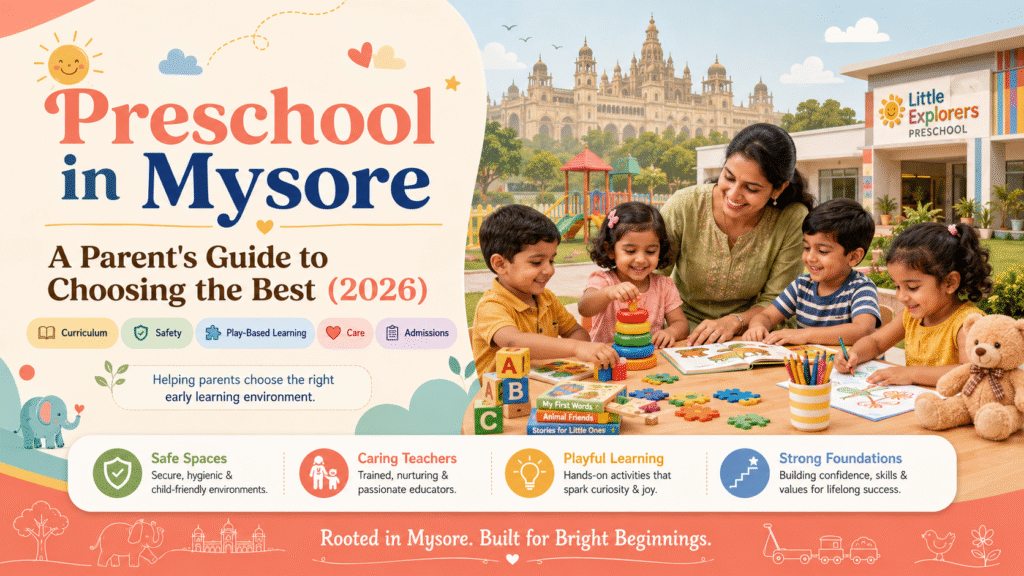
Choosing a preschool in Mysore is one of the biggest early decisions a parent makes — and often one of the most confusing. Between play schools, Montessori centres, CBSE pre-primary wings and international Early Years programmes, every option promises a “bright future.” This 2026 parent’s guide cuts through the noise. It explains what actually matters in a child’s early years, how early childhood education in India has changed under NEP 2020, and how to evaluate and shortlist the best preschool in Mysore for your child.
In this guide you’ll learn:
- Why the first five years shape everything that follows
- How NEP 2020 redefined early childhood education in India
- An 8-point checklist to judge any preschool in Mysore
- How Cambridge, CBSE and Montessori approaches differ for little learners
- The right questions to ask before you enrol
Why the Early Years Matter More Than Any Other Stage
The years between ages three and six are not “just play.” They are the period when the brain builds its core architecture for language, emotion, curiosity and social behaviour. According to India’s National Education Policy 2020, over 85% of a child’s cumulative brain development happens before the age of six — which is precisely why the policy placed early childhood at the very heart of the school system.
A good preschool does not rush children into reading and writing. It gives them confidence to speak, the freedom to explore, and the emotional security to try, fail and try again. Those habits — not early worksheets — are what predict later academic success. When you evaluate a preschool in Mysore, you are really evaluating whether it protects and nurtures this window rather than wasting it.
Early Childhood Education in India Has Fundamentally Changed
For decades, formal schooling in India began at age six with Class 1. Early childhood education in India sat outside the system — unregulated play schools on one side, Anganwadis on the other. NEP 2020 changed that. It introduced the 5+3+3+4 structure, whose first block is the Foundational Stage covering ages 3 to 8: three years of preschool followed by Classes 1 and 2. For the first time, three years of Early Childhood Care and Education (ECCE) became a formal part of school education.
To translate this into classrooms, NCERT released the National Curriculum Framework for the Foundational Stage (NCF-FS 2022) — the first ever integrated curriculum framework for children aged 3 to 8 in India. Its central idea is simple but powerful: play is the primary vehicle of learning. Structured play, stories, music, movement and hands-on activity are treated as serious pedagogy, not filler.
Parents are responding to this shift. Data from the ASER survey shows preschool enrolment climbing steadily — by 2024, close to 80% of rural three-year-olds were enrolled in some form of early childhood programme. As policy analysts at the Observer Research Foundation note, this reform has placed early education at the centre of India’s schooling vision. The takeaway for any parent researching a preschool in Mysore: early years are now recognised as foundational, so the quality of that first classroom matters enormously. You can read more about how this plays out across school stages in our guide to the best schools in Mysore.
8 Things to Look for in a Preschool in Mysore
Glossy brochures and air-conditioned lobbies tell you very little about the learning inside. Use this checklist to judge any preschool in Mysore on what genuinely affects your child:
- Play-based, activity-led learning — Look for exploration, storytelling and hands-on tasks, not rows of desks and homework for three-year-olds.
- Low student–teacher ratio — Younger children need more individual attention. Ask exactly how many children each teacher and helper manage.
- Trained, warm early-years educators — Early childhood teaching is a specialised skill. Observe how staff speak to and comfort the children.
- A genuine focus on communication and confidence — The best programmes prioritise language, self-expression and social skills over rote memorisation.
- Safety, hygiene and supervision — Secure premises, clean washrooms, safe play areas and clear pick-up protocols are non-negotiable.
- A clear curriculum framework — Whether Cambridge, CBSE-aligned or Montessori, there should be a documented progression, not ad-hoc activities.
- Transparent parent communication — Regular updates, parent–teacher interactions and an open-door culture signal a school that has nothing to hide.
- A joyful, calm atmosphere — Trust your senses on a visit. Are children engaged and happy, or anxious and restless?
Pro tip: Always visit in person during school hours. A ten-minute walk through active classrooms reveals more than any prospectus.
Cambridge vs CBSE vs Montessori: Which Approach Suits Early Years?
Curriculum is the question most parents get stuck on. At the preschool stage, the differences are less about “syllabus” and more about how children are taught to think. Here’s a simple comparison:
| Factor | Cambridge Early Years | CBSE Pre-Primary | Montessori |
|---|---|---|---|
| Core approach | Inquiry & activity-based, global outlook | Structured, exam-oriented foundation | Self-directed, child-led materials |
| Focus in early years | Curiosity, communication, problem-solving | Early literacy & numeracy readiness | Independence & sensory learning |
| Learning style | Play, stories, projects, exploration | Activity plus structured practice | Hands-on materials, individual pace |
| Best suited for | Parents wanting international standards & adaptability | Families planning a national board path | Children who thrive with independence |
There is no single “best” board — only the best fit for your child and your long-term plans. That said, the Cambridge pathway has become increasingly popular for early years because its play-and-inquiry model maps naturally onto how young children actually learn, while also opening an internationally recognised route through primary, secondary and IGCSE.
How to Choose the Best Preschool in Mysore for Your Child
Finding the best preschool in Mysore is less about rankings and more about alignment. Once you’ve shortlisted two or three schools, put each through the same set of questions before you decide:
- What does a typical day look like for a three-year-old here?
- How do you settle a child who is nervous on their first days?
- How are teachers trained specifically for early childhood?
- How will I know how my child is progressing?
- How does the preschool connect to the next stage of learning?
That last question matters more than parents realise. A strong preschool should flow smoothly into primary school without a jarring change of philosophy. Schools that offer a continuous pathway — for example, an Early Years programme that leads into a Cambridge Primary programme under one roof — spare your child the disruption of switching systems at age five or six.
Inside a Cambridge Early Years Programme
To make this concrete, here’s how a well-designed Cambridge-aligned Early Years programme is structured for the youngest learners. At Trinity International School’s Early Years programme, children aged 3+ progress through clear, age-appropriate stages:
- Nursery (3+ years): The beginning of independent discovery — exploring sounds, colours and shapes while building early motor skills, vocabulary and social interaction through music, storytelling and play.
- Lower Kindergarten (LKG, 4+ years): Structured learning gently begins — recognising numbers, letters and patterns, while imaginative play strengthens emotional understanding and teamwork.
Across these stages, learning is organised around a few foundational areas rather than “subjects”: communication and language (through songs, rhymes and stories), understanding their world (sensory and observation-led exploration), early mathematical awareness (counting, sorting and shapes through play), and physical development (movement and coordination that prepares little hands for writing). Notice how closely this mirrors the NEP 2020 foundational-stage goals — that alignment is a good sign in any preschool you consider.
Getting Admission Right: What to Prepare
Preschool admissions in Mysore are refreshingly simple compared to later stages, but planning ahead helps you secure a seat in your preferred programme. A typical process involves an enquiry, a campus visit and interaction, an age-eligibility check, and documentation. To move forward with confidence:
- Confirm your child’s age eligibility for the Nursery or LKG intake.
- Book a campus tour so you can see classrooms in action — review the how to apply steps in advance.
- Keep basic documents (birth certificate, photographs, address proof) ready.
- Ask about the fee structure early through a fee enquiry so there are no surprises.
- Apply before seats fill, as early-years cohorts are kept deliberately small.
If you’d like to understand the school’s philosophy before visiting, our About TISM page explains how global education standards are combined with strong local values — a balance many parents in Mysore are looking for.
Frequently Asked Questions
What is the right age to start preschool in Mysore?
Most children begin preschool at age 3 with Nursery, followed by Lower Kindergarten at 4+. This aligns with NEP 2020’s Foundational Stage, which formally begins the learning journey at age three through three years of play-based early childhood education before Class 1.
How do I choose the best preschool in Mysore?
Focus on play-based learning, a low student–teacher ratio, trained early-years educators, safety, and transparent parent communication. Visit in person during school hours, watch how children are engaged, and choose a programme that flows smoothly into primary school rather than one that pushes rote work too early.
Why choose the Cambridge curriculum for preschool?
The Cambridge curriculum uses inquiry and play at the early-years stage, which matches how young children naturally learn. It builds confidence, communication and problem-solving through activity-based classrooms, while offering an internationally recognised pathway that continues through primary, secondary and IGCSE.
What is the difference between Cambridge and CBSE at the preschool level?
At preschool, Cambridge leans towards inquiry, exploration and communication skills, while CBSE pre-primary emphasises structured readiness for early literacy and numeracy. Both can be excellent; the right choice depends on your child’s temperament and whether you plan an international or national board path later.
How has NEP 2020 changed early childhood education in India?
NEP 2020 brought three years of early childhood care and education into formal schooling through the 5+3+3+4 structure. Its Foundational Stage covers ages 3 to 8, and the NCF-FS 2022 framework makes play-based learning the official approach for this age group across India.
Is preschool necessary before Class 1?
Under NEP 2020, preschool is now recognised as a formal part of the Foundational Stage rather than optional preparation. Quality early years help children build language, social confidence and curiosity, giving them a smoother, stronger start when structured primary learning begins.
Making Your Decision
The best preschool in Mysore is not the one with the flashiest campus — it’s the one where your child feels safe, stays curious, and learns to love learning. Use the checklist, visit in person, ask the hard questions, and pick the programme whose philosophy matches how you want your child to grow. Get the early years right, and everything that follows becomes easier.
Ready to see a Cambridge Early Years programme up close? Contact Trinity International School, Mysore to book a campus visit and meet the early-years team.
About the Author
TISM Early Years & Admissions Team — This guide is written by the Early Years and Admissions team at Trinity International School, Mysore, a Cambridge-pathway international school on Adichunchanagiri Road, Mysore. The team works with parents of 3+ children every day and draws on hands-on experience in play-based, activity-led early childhood education aligned with the Cambridge curriculum and NEP 2020’s Foundational Stage. For admissions guidance, reach the team at info@tismysore.com or +91 990151 0055.