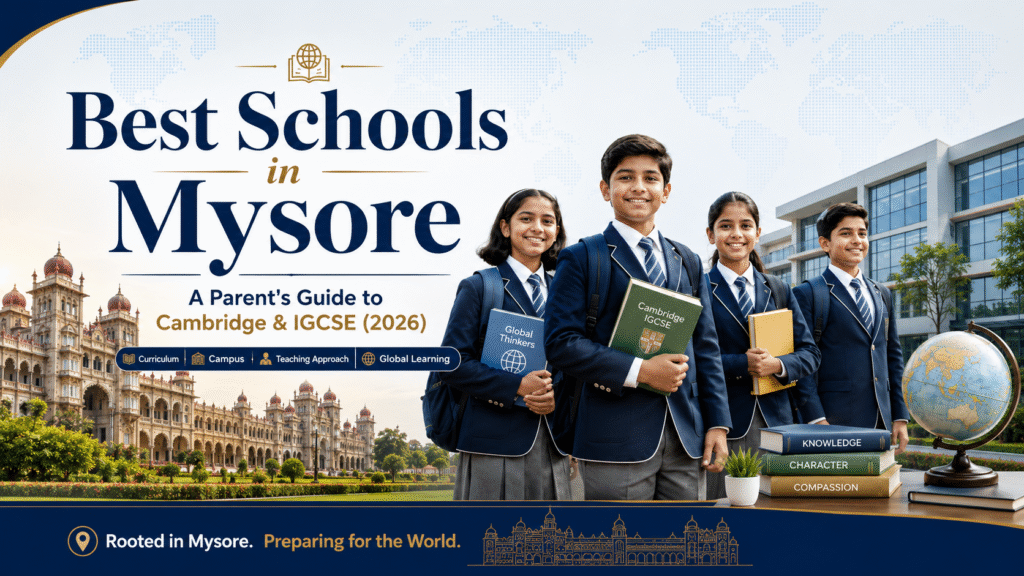
Choosing the best schools in Mysore is one of the biggest decisions a parent makes — and it rarely comes down to a single ranking or a glossy brochure. The right school is the one that matches your child’s learning style, your family’s values, and the kind of future you want to open up. This 2026 guide walks you through how to evaluate the best schools in Mysore, what the different curricula actually mean for your child, and why a growing number of families are shortlisting Cambridge curriculum and IGCSE schools in the city.
Mysore (Mysuru) has quietly become one of Karnataka’s strongest education hubs. Alongside its well-known state-board and CBSE institutions, the city now offers internationally benchmarked options — including international schools in Mysore that follow the Cambridge pathway. Below, we break the decision down into clear, practical steps.
What actually makes a school “the best” in Mysore?
There is no single “best school” — there is only the best fit for your child. That said, the strongest schools tend to share a common set of markers. When you compare the best schools in Mysore, weigh each option against these six factors rather than reputation alone:
- Curriculum and board: State board, CBSE, ICSE, or an international framework like Cambridge/IGCSE — each shapes how your child learns, not just what they learn.
- Teaching approach: Rote memorisation versus inquiry-based, activity-led learning where children question, apply, and create.
- Faculty quality: Trained, experienced teachers and healthy student-to-teacher ratios that allow individual attention.
- Assessment philosophy: Whether progress is measured fairly and continuously, or reduced to a single high-pressure exam.
- Facilities and safety: Smart classrooms, labs, libraries, play areas, and a secure, inclusive campus environment.
- Holistic development: Attention to leadership, creativity, sport, and emotional well-being alongside academics.
A quick tip: before you visit any school, write down which three of these matter most to your family. It turns an emotional decision into a structured one.
Understanding your options: State, CBSE, ICSE and Cambridge/IGCSE
The board a school follows is the single biggest factor in how your child will experience learning. Here is a plain-language comparison of the main options available in Mysore.
| Board / Curriculum | Best known for | Learning style | Global recognition |
|---|---|---|---|
| State Board (Karnataka) | Local affordability and access | Exam and syllabus focused | Primarily within Karnataka/India |
| CBSE | Competitive exam preparation (JEE/NEET) | Structured, syllabus-driven | Strong across India |
| ICSE | English and broad subject depth | Detailed, content-rich | Strong across India |
| Cambridge / IGCSE | Inquiry-based, globally portable learning | Active, application-led, concept-first | Recognised worldwide |
For families who value critical thinking and international mobility, Cambridge curriculum schools have become an increasingly popular choice — which is why they deserve a closer look.
What is the Cambridge curriculum — and why Mysore parents are choosing it
The Cambridge curriculum is an international education framework offered by Cambridge Assessment International Education (CAIE), part of the University of Cambridge. According to Cambridge International, its programmes are used in schools across more than 150 countries, making it one of the most widely recognised education systems in the world.
What sets Cambridge curriculum schools apart is the how of learning. Instead of memorising to reproduce answers, students are taught to research, reason, and reimagine — building deep conceptual understanding they can apply to real problems. This inquiry-led approach also aligns closely with India’s National Education Policy (NEP) 2020, which pushes Indian education toward exactly this kind of active, skills-based learning.
At the primary stage, this looks like activity-based lessons that build strong fundamentals in English, Math, and Science. You can see how this plays out in practice on Trinity International School’s Cambridge Primary programme (5+ years) and its Early Years programme (3+ years), where playful, caring beginnings build early literacy, numeracy, and social confidence.
IGCSE schools in Mysore: what to expect
IGCSE — the International General Certificate of Secondary Education — is the Cambridge qualification typically taken around Grade 10 (ages 14–16). Cambridge describes it as the world’s most popular international qualification for this age group, and it functions as the bridge between school and pre-university study.
When you look at IGCSE schools in Mysore, here is what a strong programme should offer:
- Subject breadth: A balanced mix across languages, humanities, sciences, mathematics, and creative/professional subjects.
- Skills over cramming: Coursework and practicals that develop application, not just recall.
- University pathways: Qualifications recognised by leading universities in India and abroad.
- Smaller class sizes: Enough individual attention for each learner to be genuinely known by their teachers.
Importantly for Indian families, Cambridge IGCSE and A Level qualifications are granted equivalence by the Association of Indian Universities (AIU), so students can transition smoothly into Indian higher education as well as international universities. In other words, choosing an IGCSE school does not close doors to Indian colleges — it keeps both paths open.
Searching for “Cambridge curriculum schools near me” in Mysore
If you have typed “Cambridge curriculum schools near me” into a search bar, you already know the results can be confusing. Many schools use “international” in their name without offering a genuine Cambridge pathway. Here is how to tell the difference and shortlist properly:
- Check for official Cambridge association. A true Cambridge curriculum school is a registered Cambridge International School able to offer CAIE programmes.
- Ask about the full pathway. Does the school offer a continuous journey from Early Years through Primary and beyond, or just a single stage?
- Visit the campus in person. Photos can be staged; a school tour reveals the real atmosphere, safety standards, and how teachers interact with children.
- Talk to current parents. First-hand experiences are the most honest signal of a school’s culture.
- Look at location and commute. “Near me” matters — a long daily commute affects your child’s energy and family routine.
For families in and around the city, a practical starting point is to explore an established international school in Mysore that follows the Cambridge framework and to see the campus and student life for yourself through TISM Moments.
A parent’s checklist for choosing the right international school in Mysore
Use this checklist on every school visit. Schools that answer these confidently — and let you see the evidence — belong on your shortlist of the best schools in Mysore.
- Is the school a recognised Cambridge curriculum school with a clear academic pathway?
- What is the student-to-teacher ratio, and how is individual attention ensured?
- How is student progress shared with parents (reports, meetings, a parent app)?
- What do the classrooms, labs, library, and play areas actually look like today?
- How does the school handle safety, inclusion, and emotional well-being?
- What co-curricular and life-skills opportunities are built into the week?
- Are the fees transparent, and what is included?
Trinity International School, Mysore: a Cambridge-focused option
Among the international schools in Mysore, Trinity International School (TISM) is built specifically around the Cambridge curriculum. Its approach blends global education standards with Indian ethos and holistic growth — nurturing curiosity, confidence, and compassion so students learn to think globally and act responsibly.
TISM offers a continuous Cambridge pathway starting from Early Years (3+ years) through Primary (5+ years), with smart classrooms, inquiry-driven lessons, experienced faculty, and a safe, inclusive campus on Adichunchanagiri Road. Learning is designed to move children beyond remembering and reproducing knowledge toward researching, reasoning, and reimagining.
If TISM sounds like a fit for your family, the next steps are simple: review the how to apply process, raise a fees enquiry, or contact the admissions team to book a campus tour. You can also read more parenting and education insights on the TISM blog.
Frequently asked questions
Which are the best schools in Mysore?
The best schools in Mysore are the ones that match your child’s learning style and your family’s priorities. Strong contenders share clear markers: a well-defined curriculum, inquiry-based teaching, experienced faculty, fair assessment, safe facilities, and a focus on holistic development. Cambridge curriculum schools like Trinity International School are popular among parents seeking globally recognised, skills-first education.
What is the difference between IGCSE and CBSE schools in Mysore?
CBSE is an Indian national board known for structured, exam-focused preparation, especially for competitive exams. IGCSE is an international Cambridge qualification that emphasises inquiry, application, and global recognition. IGCSE schools in Mysore suit families who value critical thinking and international university options, while keeping Indian pathways open through AIU equivalence.
Are Cambridge and IGCSE qualifications recognised in India?
Yes. Cambridge IGCSE and A Level qualifications are granted equivalence by the Association of Indian Universities (AIU), so students can enter Indian universities as well as international ones. Cambridge qualifications are recognised by leading universities worldwide, making them a flexible, future-ready choice for students in Mysore.
How do I find Cambridge curriculum schools near me in Mysore?
Search for registered Cambridge International Schools rather than relying on names alone, confirm they offer a continuous Cambridge pathway, and visit the campus in person. Talking to current parents and checking the daily commute will help you shortlist the right international school in Mysore for your family.
What age can my child start at a Cambridge school in Mysore?
Most Cambridge curriculum schools, including Trinity International School, welcome children into Early Years from around age 3, followed by Primary from around age 5. Starting early helps children build strong literacy, numeracy, and social foundations within the inquiry-based Cambridge approach.
Making your decision
Finding the best school in Mysore is less about chasing a label and more about matching the right environment to your child. Compare boards honestly, prioritise the factors that matter most to your family, and always visit before you decide. For parents drawn to globally recognised, inquiry-led education, Cambridge curriculum and IGCSE schools in Mysore — such as Trinity International School — are well worth a closer look.
Ready to take the next step? Book a campus visit with Trinity International School, Mysore and see inquiry-based Cambridge learning in action.
About Trinity International School, Mysore: TISM is a Cambridge-curriculum international school in Mysuru offering a continuous learning pathway from Early Years (3+) through Primary (5+). The school combines global education standards with Indian values, focusing on inquiry-based learning, experienced faculty, and holistic development. Learn more about TISM.