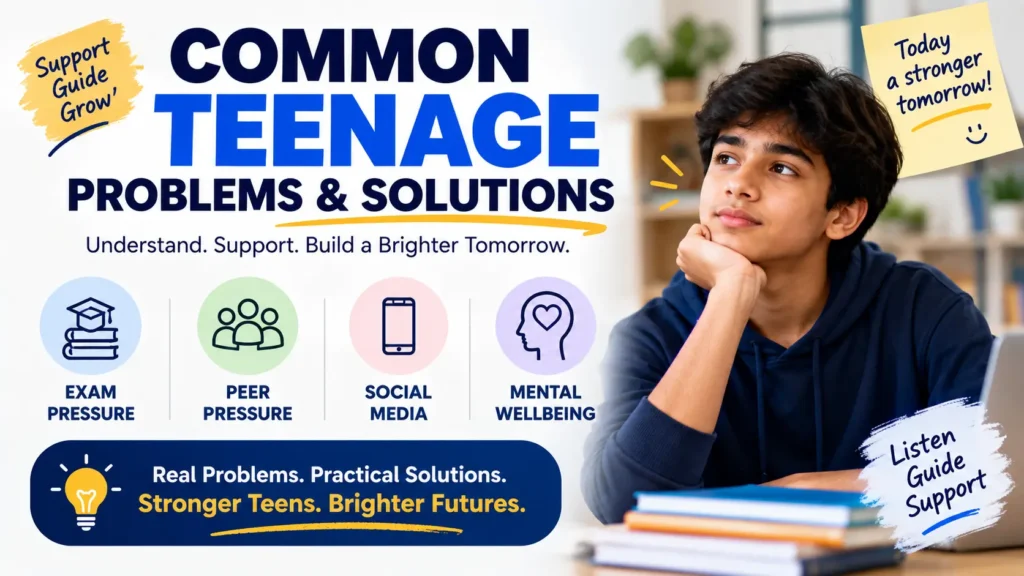
The most common teenage problems are academic and exam pressure, peer pressure, body image and self-esteem, social media comparison, conflict with parents, sleep deprivation, loneliness, and uncertainty about the future. The solutions are rarely dramatic. In almost every case they involve the same three things: an adult who listens without immediately correcting, a reduction in the specific pressure rather than advice about coping with it, and early help from a counsellor or doctor when a difficulty lasts beyond a few weeks and starts affecting sleep, appetite, school or friendships.
Key Takeaways
- This is not rare. WHO estimates that around one in seven 10–19-year-olds worldwide experiences a mental health condition, and that most go unrecognised and untreated.
- Indian students name exams first. NCERT’s 2022 Manodarpan survey of 3.79 lakh students in Classes 6–12 found that around 81% linked their anxiety to studies, exams and results.
- Satisfaction drops in senior school. The same survey found personal and school-life satisfaction declining as students moved from middle to secondary stage.
- Body image is a large, under-discussed issue. More than 45% of students surveyed reported dissatisfaction with their body image.
- Peer pressure is close to universal. Around a third of students said they go along with peers most of the time.
- Most teenagers have nobody to tell. A recurring finding in the survey was that students had no available person with whom to discuss their feelings, even though they readily support others.
- Listening beats advising. The single most useful thing an adult can do is hear the whole problem before responding to any part of it.
What This Article Covers
- What Are the Most Common Teenage Problems?
- Why Adolescence Is Genuinely Harder Than It Looks
- 8 Common Teenage Problems and Solutions
- How Parents Can Help Without Making It Worse
- What Schools Can Do for Teenage Students
- When to Seek Professional Help
- How Trinity International School Mysore Supports Teenage Students
- Frequently Asked Questions
A parent notices that a cheerful thirteen-year-old has become a closed door and a phone screen. Marks slip slightly. Conversations shorten to single words. Everyone says this is normal, and mostly it is, but that word covers both an ordinary phase and something that needs attention, and no parent can tell from the outside which one they are looking at.
That uncertainty is what makes the teenage years so hard to parent. The difficulties are common, but the response has to be specific.
This guide sets out the eight problems that come up most often for teenage students, what each one actually looks like from the inside, and what helps. It is written for parents and teachers, drawing on national survey data from Indian schools alongside global adolescent health research.
One note before starting. Nothing here replaces a doctor or a counsellor. If something has lasted for weeks and is changing how your child sleeps, eats, studies or spends time with friends, that is the point at which professional help stops being an overreaction and starts being sensible.
What Are the Most Common Teenage Problems?
Ask a room of Indian teenagers and the same list comes back: exams, parents, friends, appearance, phones, sleep, and not knowing what happens after Class 12.
National data supports that ordering. NCERT’s Manodarpan cell surveyed 3.79 lakh students in Classes 6 to 12 across 36 states and union territories in early 2022. Around 81% of students connected their anxiety to studies, examinations and results. More than 45% reported dissatisfaction with their body image. Roughly a third said they went along with peer pressure most of the time. Satisfaction with both school life and personal life fell noticeably as students moved from middle school into the secondary stage.
Globally, the picture is consistent. WHO estimates that about one in seven adolescents aged 10 to 19 experiences a mental health condition, with anxiety and depression the most common, and notes that these largely go unrecognised and untreated. Roughly half of all mental health conditions begin before the age of 18.
The takeaway is not that every teenager is in difficulty. It is that difficulty at this age is ordinary, treatable, and far more often missed than overreacted to.
Why Adolescence Is Genuinely Harder Than It Looks
Three things happen at once during the teenage years, and they interfere with each other.
The brain is rewiring. The systems governing emotion and reward mature earlier than the systems governing planning and impulse control. That mismatch is why a teenager can be genuinely intelligent and still make a decision that looks inexplicable to an adult. It is developmental, not a character flaw.
Identity moves outward. Peer opinion begins to outweigh family opinion. This is not rejection; it is the normal work of becoming a separate person. It just happens to feel like rejection to the parent living through it.
The stakes become permanent. For Indian students in particular, board exams, streams and entrance tests arrive at exactly the age when emotional regulation is least developed. A fifteen-year-old is being asked to make decisions with lifelong consequences using a brain that is still under construction.
Understanding this does not make the behaviour easier to live with. It does change what an adult chooses to respond to, and what they let pass.
8 Common Teenage Problems and Solutions
For each one: what it looks like, and what actually helps.
1. Academic and exam pressure
The most reported problem by a wide margin. It shows up as procrastination that looks like laziness, physical complaints before tests, irritability during exam months, and a flat refusal to discuss marks. Many students also report believing they will not be respected if they do not do well, which turns every test into a referendum on their worth.
What helps:
- Separate effort from result in how you talk. Ask what they studied, not only what they scored.
- Say out loud, more than once, that your affection does not depend on marks. Teenagers do not assume this.
- Break revision into short defined blocks rather than open-ended hours at a desk.
- Remove one commitment during exam months rather than adding a coaching class.
- Watch for exam anxiety that produces physical symptoms, that warrants a counsellor, not a pep talk.
2. Peer pressure and fitting in
Around a third of surveyed students said they comply with peers most of the time. It is rarely dramatic. It looks like changing an opinion, dropping a hobby that is considered uncool, staying silent when a friend is mocked, or agreeing to something they are uncomfortable with because refusing costs more.
What helps:
- Rehearse refusals in advance. A teenager who has practised a specific sentence uses it; one who has only been warned does not.
- Give them a face-saving exit, an agreed code word or message that brings a parent to collect them with no questions asked that night.
- Criticise the behaviour, never the friend. Attacking friendships drives the information underground.
- Help them build one interest outside the school peer group, where a different version of them exists.
3. Body image and self-esteem
More than 45% of students in the NCERT survey reported dissatisfaction with their body image, making this one of the largest and least-discussed teenage problems. It shows up as reluctance in photographs, avoiding certain clothes, sensitivity to ordinary remarks, and withdrawal from sport or swimming.
What helps:
- Stop commenting on bodies at home: your child’s, your own, relatives’, or people on screen. Household habit shapes this more than anything said directly.
- Praise things unrelated to appearance, specifically and often.
- Name the filters. Teenagers know images are edited, but knowing and feeling are different things.
- If eating, exercise or body-related behaviour changes noticeably, speak to a doctor or counsellor early rather than managing it at home.
4. Social media and constant comparison
Every teenager now measures their ordinary life against other people’s edited highlights, continuously, from a device beside their pillow. The effects surface as late nights, low mood after scrolling, anxiety about being excluded, and a distorted sense of what everyone else’s life looks like.
What helps:
- Set a household rule, not a teenager-only rule: no phones in bedrooms overnight, adults included.
- Negotiate limits rather than imposing them, a teenager who helped set the rule will follow it further.
- Ask what they saw, not just how long they were on it. The content matters more than the minutes.
- Teach the mechanics: these platforms are designed to hold attention. Most teenagers respond well to being told how the manipulation works.
5. Conflict with parents
Arguments over autonomy, phones, timings, friends and tone. Both sides usually believe they are being reasonable and unheard, and both are partly right.
What helps:
- Pick two or three rules that genuinely matter: safety, school, honesty, and concede ground on the rest. Teenagers need somewhere to win.
- Do not open a serious conversation in the first ten minutes after they get home.
- Let them finish the whole sentence before responding to any part of it. Most teenagers stop talking because they are interrupted.
- Apologise when you are wrong. It costs nothing and buys years of credibility.
6. Sleep deprivation and exhaustion
Adolescent body clocks shift later naturally, and school start times do not move. Add homework, coaching and a phone, and chronic short sleep becomes normal. The result is misread as attitude: irritability, poor concentration, low mood, falling marks.
What helps:
- Treat sleep as an academic intervention, because it is one. It affects marks more reliably than an extra hour of revision.
- Keep the last hour before bed screen-free, with the phone charging outside the bedroom.
- Protect a consistent wake-up time, including weekends, variability does more damage than a late night.
- If a teenager sleeps well and is still exhausted for weeks, see a doctor. Persistent fatigue has medical explanations worth ruling out.
7. Loneliness in a connected life
One of the more striking findings in the NCERT survey was how many students reported having nobody available to discuss their feelings with, even while they regularly supported others. A teenager can have four hundred contacts and no one to tell.
What helps:
- Create low-pressure time together: a drive, a walk, a shared chore. Teenagers talk sideways, not face to face.
- Ask specific questions. “How was school” invites nothing; “Who did you sit with at lunch” invites an answer.
- Help them name two adults besides you they could go to. Widening the circle protects them.
- Take reported loneliness seriously the first time. Most teenagers only say it once.
8. Uncertainty about the future
Stream selection, entrance exams, career choices, and the sense that a decision made at sixteen is irreversible. The pressure is amplified when a family has a strong preference and the student does not share it.
What helps:
- Show them that careers change. Most working adults are not doing what they planned at seventeen, and hearing this from a parent lowers the stakes considerably.
- Arrange conversations with people in three or four different fields. Exposure beats advice.
- Separate the entrance exam from the identity. Not clearing one test closes one route, not a life.
- If the family expectation and the student’s interest genuinely differ, name that openly rather than letting it stay unspoken.
How Parents Can Help Without Making It Worse
Five things that apply across every problem on this list.
- Listen first, and longer than feels natural. Most teenagers stop confiding because the adult started solving before they had finished explaining.
- Do not minimise. “This will seem small later” is true and useless. It does not seem small now, and now is where they live.
- Reduce the pressure, don’t just coach them through it. If the schedule is genuinely unmanageable, removing something helps more than a conversation about time management.
- Keep confidences unless there is a safety concern. One breach, repeating something to a relative, for instance, can end disclosure for years.
- Look after yourself too. An exhausted, anxious parent is the least useful version of a parent, and teenagers read stress in a house accurately.
What Schools Can Do for Teenage Students
Schools see teenagers for more waking hours than most families do, which makes them well placed to notice change early.
- A counsellor students can reach without a parent or teacher arranging it
- Class teachers trained to notice sudden changes in attendance, marks, appearance or friendship groups
- Life-skills sessions on stress, sleep, online life and emotional regulation, taught as curriculum rather than as an annual assembly
- Realistic academic messaging, especially in board exam years
- A clear, followed anti-bullying process, including online bullying
- Parent sessions, so that home and school respond to the same situation in similar language
When to Seek Professional Help
Ordinary teenage difficulty resolves over days and does not stop the rest of life. Consider speaking to a school counsellor, doctor or mental health professional when:
- A change in mood, sleep, appetite or energy has lasted more than two to three weeks
- They have withdrawn from friends and activities they previously enjoyed
- Marks or attendance have dropped sharply without an obvious reason
- Anxiety is producing physical symptoms, or they are avoiding school
- You notice changes in eating or self-care that concern you
- Something feels wrong to you and you cannot say precisely what
That last one is a legitimate reason. Parents are usually right about their own child, and an unnecessary consultation costs far less than a delayed one.
Where to find support in India
Tele-MANAS, 14416. The Government of India’s free 24×7 mental health helpline, available in English and 20 regional languages.
Childline, 1098. A free national helpline for children and adolescents.
Your school counsellor, a paediatrician, or a registered psychologist can also assess and refer. Speaking to someone early is not an overreaction.
How Trinity International School Mysore Supports Teenage Students
The secondary years are where students most need someone in school who is not only marking their work.
At Trinity, our class teachers are the first line, they know their students well enough to notice when something has shifted, and they raise it early rather than waiting for a report card to say it. We cover stress, sleep, online life and emotional regulation as part of life-skills teaching rather than as a one-off talk. Students can approach a counsellor without needing a parent or teacher to arrange it first.
We also talk to parents plainly during board exam years, because a great deal of what a fifteen-year-old carries is picked up at home rather than in class. When school and family are saying the same thing, a teenager has far less to manage on their own.
Frequently Asked Questions
What are the most common teenage problems and solutions?
The most common teenage problems are exam pressure, peer pressure, body image concerns, social media comparison, conflict with parents, sleep deprivation, loneliness and uncertainty about the future. The solutions consistently involve listening without immediately advising, reducing the specific pressure rather than coaching around it, and seeking professional help early when a difficulty persists.
What is the biggest problem faced by teenage students in India?
Academic pressure. NCERT’s 2022 Manodarpan survey of 3.79 lakh students in Classes 6–12 found around 81% linked their anxiety to studies, exams and results, and that satisfaction with school and personal life declined as students moved into the secondary stage.
How do I get my teenager to talk to me?
Use low-pressure settings: a drive, a walk, a shared task, rather than face-to-face conversations. Ask specific questions instead of general ones, let them finish before responding, and keep what they tell you confidential unless safety is involved.
Is peer pressure really that common?
Yes. Around a third of students in the NCERT survey reported going along with peers most of the time. It usually looks small: changing an opinion, dropping a hobby, staying quiet, rather than dramatic, which is exactly why it is easy for parents to miss.
How much sleep does a teenager need, and why does it matter?
Adolescents typically need eight to ten hours, and most Indian students get considerably less. Short sleep shows up as irritability, poor concentration and falling marks, which are often misread as attitude problems rather than exhaustion.
When should parents seek professional help for a teenager?
When a change in mood, sleep, appetite or energy lasts beyond two to three weeks, when they withdraw from friends and activities, when school performance drops sharply without explanation, or when something simply feels wrong to you. Early consultation is sensible, not excessive.
Are these problems a sign of bad parenting?
No. WHO estimates around one in seven adolescents worldwide experiences a mental health condition, across every kind of family. What matters is not whether difficulties appear, but whether they are noticed early and responded to with support rather than blame.
Conclusion
Almost every problem on this list is ordinary, and almost every one improves with the same ingredients: an adult who listens properly, a pressure genuinely reduced rather than reframed, and professional help brought in early instead of late.
What teenagers most often lack is not advice. Survey after survey finds the same gap, they have nobody available to talk to. Being that person is unglamorous work, mostly done in cars and kitchens and at bedroom doors, and it matters more than any single intervention.
If you are unsure whether what you are seeing is a phase or something more, ask someone. A school counsellor, a paediatrician or a helpline can tell you in one conversation what you might otherwise spend six months wondering about.
Adolescence is easier when school and home work together.
Trinity International School Mysore supports teenage students through counsellor access, life-skills teaching and class teachers who know their students well enough to notice early.
Visit our campus in Mysuru, or book a school tour to meet our teachers and understand how we approach student wellbeing.
Call us at [phone number] | Write to us at [email]
Sources
- World Health Organization, Mental health of adolescents fact sheet: https://www.who.int/news-room/fact-sheets/detail/adolescent-mental-health
- WHO and UNICEF, Mental Health of Children and Young People: Service Guidance: https://www.who.int/news/item/09-10-2024-who-and-unicef-launch-guidance-to-improve-access-to-mental-health-care-for-children-and-young-people
- NCERT Manodarpan Cell, Mental Health and Well-being of School Students: A Survey, 2022: https://ncert.nic.in
- Ministry of Education, Government of India, Manodarpan initiative: https://manodarpan.education.gov.in
- Ministry of Health and Family Welfare, Government of India, Tele-MANAS national mental health helpline (14416): https://telemanas.mohfw.gov.in
About the Author
Dr Shama E Milton
Principal, Trinity Institutions, Mysuru
Dr Shama E Milton leads Trinity Institutions, Mysuru, overseeing academic direction and student wellbeing across the group’s schools and colleges. She works with class teachers, counsellors and parents on adolescent wellbeing, exam stress and life-skills education, and writes on how families and schools can support students through the secondary years.
This article is for general information and does not replace advice from a doctor, counsellor or qualified mental health professional.