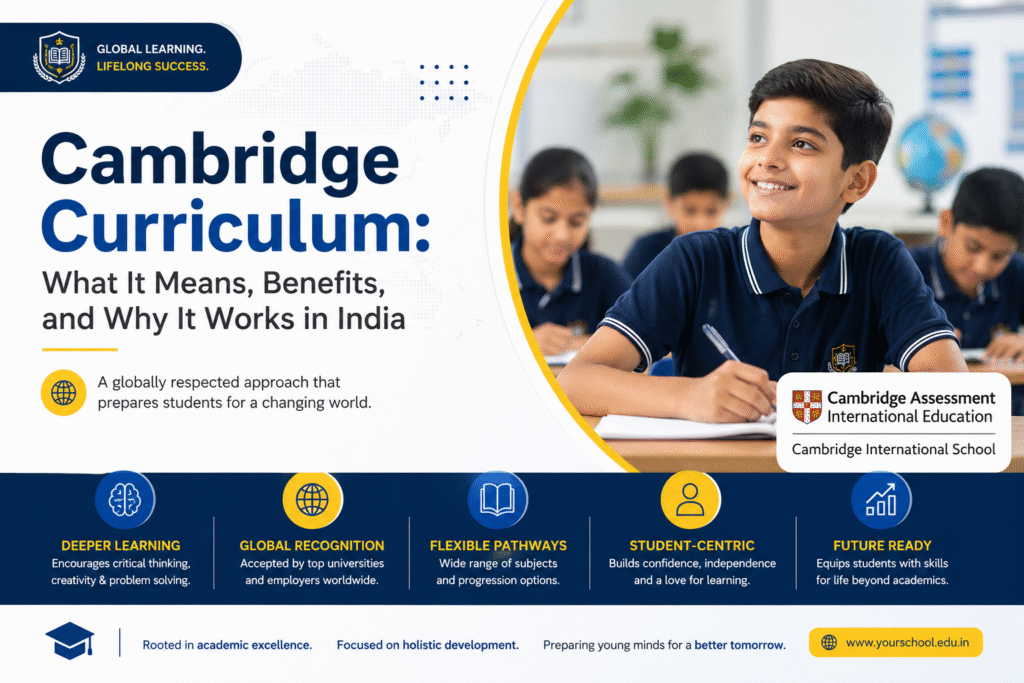
The Cambridge curriculum is a globally recognised framework of education developed by Cambridge Assessment International Education, part of the University of Cambridge in the UK. It guides learners from age 5 through to 19 across four connected stages, and it is taught in more than 10,000 schools in over 160 countries. For Indian parents weighing up their child’s schooling, understanding what the Cambridge curriculum is, and whether it fits your family, has become one of the most important early decisions you will make.
This guide breaks down what the Cambridge curriculum means, how its stages work, how it is recognised in India, the real benefits it offers, and the honest question every parent asks: is it actually good for my child? By the end you will have a clear, practical picture rather than marketing gloss.
What Is the Cambridge Curriculum?
The Cambridge curriculum is an international education system that sets clear learning goals for each stage of a child’s schooling, from primary school to pre-university level. In simple terms, the Cambridge curriculum means a structured, skills-focused pathway that prioritises understanding and application over rote memorisation.
It is often called the “British curriculum” because it grew out of the UK education system, but it was designed specifically for an international audience. Subjects are taught in English, with content that stays relevant across cultures rather than being tied to any single country. That is why a child studying the Cambridge curriculum in Mysore learns the same core framework as a child in London, Dubai, or Singapore.
At its heart, the curriculum is built around four ideas: deep subject knowledge, the ability to think independently, strong communication skills, and a genuine curiosity for learning. Assessment combines coursework, practical work, and written exams, so a child is judged on more than their memory alone.
The Cambridge Pathway: Four Stages Explained
The Cambridge Pathway is the sequence a learner follows as they progress. Each stage builds on the one before, which gives children a continuous, well-planned journey rather than disconnected years of study.
1. Cambridge Primary (ages 5 to 11)
This stage lays the foundation in English, mathematics, science, and other core subjects through activity-based, inquiry-led learning. The focus is on building confidence and strong fundamentals. Before this, many families begin with the early years, and you can read more about that phase in our guide to choosing a preschool in Mysore. At Trinity, this stage is delivered through our Cambridge Primary programme, which follows the early years foundation set out on our Early Years page.
2. Cambridge Lower Secondary (ages 11 to 14)
Learners move into more specialised subjects and start developing the independent thinking and problem-solving habits they will need later. Checkpoint assessments at the end of this stage give teachers and parents a clear picture of where a child stands against international benchmarks.
3. Cambridge Upper Secondary / IGCSE (ages 14 to 16)
This is the stage most parents have heard of. The Cambridge IGCSE (International General Certificate of Secondary Education) is the world’s most popular international qualification for 14 to 16 year olds. Learners choose from a wide range of subjects and sit externally marked exams, earning a separate grade for each subject on an A* to G scale.
4. Cambridge Advanced / AS & A Level (ages 16 to 19)
The final stage prepares students for university. Cambridge International AS and A Levels let learners specialise in three or four subjects in real depth. These qualifications are the native entry route into UK universities and are accepted for admission across 160+ countries, including India.
Cambridge Curriculum in India: Recognition and Equivalence
One question dominates every conversation about the Cambridge curriculum in India: will my child’s qualification be accepted here? The short answer is yes. Cambridge IGCSE and A Level qualifications are formally recognised by the Association of Indian Universities (AIU), the nodal body that grants equivalence to foreign school qualifications.
According to the AIU and Cambridge’s own recognition guidance for India, the equivalence works like this:
- IGCSE: Five passes, including English, are treated as equivalent to Class 10 of an Indian board.
- AS & A Levels: Passes at A Level are recognised as equivalent to the 10+2 (Class 12) stage, giving access to bachelor’s degree programmes at Indian universities.
This mirrors how CBSE works: a student who finishes Class 10 still needs Class 11 and 12 before university. In the Cambridge pathway, that progression is IGCSE followed by A Levels. Major institutions such as Delhi University, Christ University, NMIMS, and Ashoka University admit students through this route, and even the IITs accept A Level students who take the required subjects and clear JEE. There are roughly 450 Cambridge-affiliated schools across India, concentrated in cities like Bengaluru, Mumbai, Delhi-NCR, Hyderabad, and Pune. You can verify current recognition on the official Cambridge India recognition page.
One practical point worth planning for: families should apply for the AIU equivalence certificate well ahead of Indian university deadlines, since it is the document most admissions offices ask to see.
Benefits of the Cambridge Curriculum
The benefits of the Cambridge curriculum come down to how it shapes the way a child thinks, not just what they know. Here is what stands out for most families:
- Global recognition: Cambridge qualifications open doors to universities and employers in 160+ countries, giving your child genuine international mobility.
- Skills over cramming: The curriculum rewards analysis, application, and reasoning, which prepares students for real academic and workplace challenges.
- Subject flexibility: With a wide subject choice at IGCSE and A Level, students can build a combination that matches their strengths and career goals.
- Consistent, external standards: Exams are externally marked and moderated each session, so grades reflect a genuine international benchmark rather than school-set marking.
- English proficiency: Because instruction and assessment are in English, students develop strong communication skills that carry into higher education and careers.
- A smooth, connected journey: The four stages fit together, so children are not left adjusting to a new system every few years.
These benefits are a large part of why so many families comparing the best schools in Mysore now shortlist Cambridge schools alongside traditional boards.
Is the Cambridge Curriculum Good? An Honest Answer
The Cambridge curriculum is a genuinely strong choice for most children, but “good” depends on what you want for your child. It is worth being honest about both sides.
It suits families who value conceptual understanding, international options, subject flexibility, and a learning style that encourages questions. Children who enjoy exploring ideas rather than memorising them tend to thrive.
Two things to plan for. First, the AIU equivalence step is an extra administrative task for Indian university admission, so it needs to be handled on time. Second, if your child is set on JEE or NEET, which are closely aligned to the CBSE syllabus, you will want a school that supports that preparation alongside the Cambridge programme, or a considered subject choice at A Level. Cambridge schools also tend to charge higher fees than most CBSE or state-board schools, which is a real budgeting factor for many families.
None of these are flaws in the curriculum itself. They are simply factors to weigh, and a good Cambridge school will guide you through each of them.
Why Choose the Cambridge Curriculum Over CBSE or ICSE?
Parents often ask why they should choose the Cambridge curriculum when CBSE and ICSE are well established in India. The honest answer is that all three are respected systems, but they optimise for different outcomes. The table below compares them at a glance.
| Factor | Cambridge (IGCSE / A Level) | CBSE / ICSE |
|---|---|---|
| Recognition | 160+ countries, plus India via AIU | Primarily India, widely accepted abroad with steps |
| Learning style | Application and analysis led | Structured, content and syllabus led |
| Subject choice | Highly flexible | More fixed combinations |
| Assessment | Coursework, practical and external exams | Mainly annual/board exams |
| Best fit for | Global options and conceptual learners | Indian entrance exams (JEE/NEET) focus |
If your priority is international university access and a curriculum that builds independent thinkers, Cambridge is a natural fit. If your child’s path is firmly toward Indian competitive exams, a board with tighter JEE/NEET alignment may feel more comfortable. Many families in Mysore now choose Cambridge precisely because it keeps the most doors open for the longest time.
The Cambridge Curriculum in Mysore: The TISM Approach
At Trinity International School Mysore (TISM), the Cambridge curriculum is delivered with a simple philosophy: global education standards grounded in Indian values. Every stage, from the early years through primary and beyond, is designed to nurture curiosity, confidence, and character, with inquiry-based, student-centred teaching and trained faculty.
The result is a learning environment where children are encouraged to question, connect, and create rather than simply reproduce what they have read. Smart classrooms, hands-on projects, and continuous assessment keep learning practical and memorable.
If you are exploring a Cambridge education for your child in Mysore, you can see how to apply, request the fee details, or simply get in touch with our team to visit the campus.
Frequently Asked Questions
What does the Cambridge curriculum mean?
The Cambridge curriculum means an international education framework, developed by Cambridge Assessment International Education, that guides learners from age 5 to 19. It emphasises understanding, application, and independent thinking over memorisation, and it is taught in English in more than 160 countries.
Is the Cambridge curriculum recognised in India?
Yes. The Association of Indian Universities (AIU) recognises Cambridge IGCSE as equivalent to Class 10 and Cambridge A Levels as equivalent to Class 12. This makes students eligible for admission to Indian universities, including central universities and the IITs, subject to their entry requirements.
Is the Cambridge curriculum good for my child?
For most children, yes. It is especially strong for learners who enjoy conceptual thinking and want international university options. Families should plan for the AIU equivalence step and, if aiming for JEE or NEET, choose subjects and support carefully alongside the Cambridge programme.
Why choose the Cambridge curriculum over CBSE?
Choose Cambridge if you value global recognition, flexible subject choices, and an application-led learning style that builds independent thinkers. CBSE may suit families focused mainly on Indian competitive exams. Both are respected; they simply prioritise different outcomes.
What are the stages of the Cambridge curriculum?
There are four connected stages: Cambridge Primary (ages 5 to 11), Cambridge Lower Secondary (11 to 14), Cambridge Upper Secondary or IGCSE (14 to 16), and Cambridge Advanced or AS & A Level (16 to 19). Each stage builds on the previous one.
Is Cambridge the same as IGCSE?
Not exactly. IGCSE is one stage within the wider Cambridge curriculum, taken at ages 14 to 16. The full Cambridge pathway spans primary school through to A Levels, with IGCSE sitting in the upper-secondary phase before A Level study.
Final Thoughts
The Cambridge curriculum offers Indian families a rare combination: a globally respected qualification, a learning style that builds thinkers rather than memorisers, and clear recognition here at home through the AIU. It is not the only good option, but for parents who want to keep the widest range of futures open for their child, it is one of the strongest.
If you would like to see how a Cambridge education looks in practice in Mysore, explore the programmes at Trinity International School Mysore or book a campus visit. The right school makes the curriculum come alive.
Written by the Academic Team at Trinity International School Mysore (TISM), a Cambridge-focused international school in Mysore. Our team works with Cambridge-trained faculty to guide families through curriculum choices, admissions, and the Cambridge Pathway from early years to A Level. Last updated: July 2026.