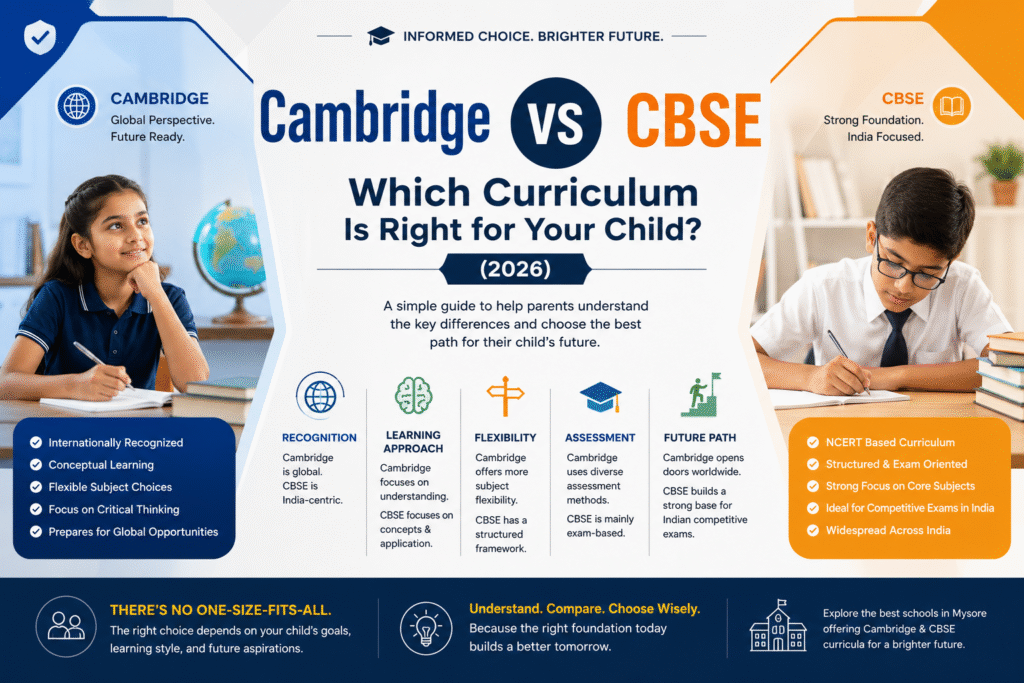
Choosing between Cambridge vs CBSE is one of the biggest decisions a parent makes long before a child ever sits an exam. Both boards can give your child a strong education, but they take very different routes to get there. CBSE follows a structured, nationally standardised path built around India’s competitive exam system. The Cambridge curriculum leans on inquiry, application, and flexible subject choice with worldwide recognition. This guide breaks down the real difference between CBSE and Cambridge curriculum so you can choose with confidence.
At Trinity International School, Mysore, we work with families weighing exactly this choice every admissions season, so the comparison below is written from the questions parents actually ask us.
Cambridge vs CBSE: quick comparison at a glance
Before the detail, here is how the two boards line up on the points parents care about most.
| Aspect | CBSE | Cambridge (IGCSE & A Level) |
|---|---|---|
| Governing body | Central Board of Secondary Education, Government of India (NCERT-based) | Cambridge Assessment International Education (CAIE), University of Cambridge |
| Recognition | Recognised across India; widely accepted for Indian universities | Recognised in 160+ countries; accepted in India via AIU equivalence |
| Learning style | Structured, textbook-led, exam-focused | Inquiry-based, application-led, concept-focused |
| Subject flexibility | Fixed streams (Science, Commerce, Humanities) in senior school | 70+ subjects; mix and match across disciplines |
| Assessment | Year-end board exams (Class 10 & 12) | Staged exams, coursework and practicals across the pathway |
| Grading | Marks and CGPA grade points | A*–G (IGCSE) and A*–E (A Level) |
| Language | English plus Hindi or a regional language | Primarily English |
| Best suited for | Families focused on JEE, NEET and Indian universities | Families wanting global mobility and flexible pathways |
What is the CBSE curriculum?
CBSE is India’s national board, run by the Central Board of Secondary Education under the Government of India. It follows the NCERT syllabus, which keeps content consistent for thousands of affiliated schools across the country.
The structure is familiar to most Indian parents. Students sit the All India Secondary School Examination in Class 10 and the All India Senior School Certificate Examination in Class 12. In senior school, learners pick a stream such as Science, Commerce, or Humanities, with English and one more language usually compulsory.
CBSE’s biggest practical strength is alignment with Indian competitive exams. JEE, NEET, and most state CETs are built on the NCERT syllabus, so a CBSE student is already studying much of what those exams test. For families whose goal is an Indian engineering or medical seat, that overlap saves real time and stress.
What is the Cambridge curriculum?
The Cambridge curriculum is delivered by Cambridge Assessment International Education, part of the University of Cambridge. It runs as a continuous pathway: Cambridge Primary, then Lower Secondary, then IGCSE (usually Grade 9–10, ages 14–16), and finally AS and A Levels in Grades 11 and 12.
Rather than moving students through fixed streams, Cambridge lets them choose from more than 70 subjects and build combinations that fit their strengths. The teaching emphasis is on understanding why something works, applying it to real situations, and forming independent opinions instead of reproducing textbook answers.
At Trinity, that pathway starts early. Our Cambridge Early Years programme introduces play-based learning at age three, and the Cambridge Primary years build reading fluency, number sense, and inquiry habits from age five.
Difference between CBSE and Cambridge curriculum: 7 key points
Most comparisons stop at “one is Indian, one is international.” The real difference between CBSE and Cambridge curriculum shows up across seven areas that shape your child’s day-to-day learning.
1. Governing body and recognition
CBSE is recognised by the Government of India and accepted by Indian universities without extra paperwork. Cambridge is recognised in over 160 countries. Inside India, Cambridge qualifications are validated through an equivalence certificate from the Association of Indian Universities (AIU), which confirms IGCSE as equivalent to Class 10 and A Levels as equivalent to Class 12.
2. Teaching philosophy
This is where the two boards feel most different in the classroom. CBSE tends toward structured, textbook-driven teaching that rewards accuracy and thorough revision. Cambridge is inquiry-led: students investigate, question, and apply concepts to unfamiliar problems. If you are wondering how is Cambridge curriculum different from CBSE in practice, this is the clearest answer. Cambridge asks “what would you do with this?” more often than “can you recall this?”
3. Subject choice and flexibility
CBSE senior students select a stream and study a set combination, typically six subjects in Class 12. Cambridge students usually take five to fourteen IGCSE subjects across languages, sciences, humanities, mathematics, and creative fields, then narrow to three or four specialised A Levels. A student can pair Physics with Economics and Art without being locked into a single stream.
4. Assessment and exams
CBSE relies on year-end board exams that carry most of the weight, supported by internal projects. Cambridge spreads assessment across the pathway with staged exams, coursework, and practical papers. Because Cambridge exams can be taken in stages, the pressure of a single make-or-break year is reduced, and students get feedback earlier.
5. Grading system
CBSE reports performance through marks and CGPA grade points. Cambridge uses A* to G for IGCSE and A* to E for A Levels, with A* to C generally seen as strong for university entry. Parents moving between systems should note that these scales are not directly interchangeable.
6. University pathways in India and abroad
Both boards open doors, but the routes differ. CBSE flows straight into Indian university admissions. Cambridge students apply to Indian universities such as Delhi University, Christ University, Ashoka, and NMIMS using their AIU equivalence certificate, and to overseas universities across the UK, US, Australia, and Singapore, where Cambridge qualifications are well understood.
7. Fees and availability
CBSE schools are far more numerous and generally more affordable. Cambridge schools are fewer and usually charge more, with annual fees at many Indian international schools falling roughly between ₹1.5 lakh and ₹3.7 lakh depending on the city, grade, and facilities. You can request specific fee details from any school you shortlist.
How is Cambridge curriculum different from CBSE for JEE and NEET?
This is the question that decides many admissions, so it deserves an honest answer. JEE and NEET are tightly aligned with the NCERT and CBSE syllabus, in both content and question style. A CBSE student is preparing for these exams simply by studying their board syllabus.
Cambridge A Level students are eligible to sit JEE and NEET, and those who study Physics, Chemistry, and Mathematics have the right subject base. In practice, though, they usually need NCERT-focused supplementary coaching to match the exam pattern. Some families choose the Cambridge pathway through IGCSE for its strong foundation, then move to CBSE or state board for Grades 11 and 12 if a JEE or NEET seat is the specific goal.
The takeaway is simple. If an Indian engineering or medical seat is the single priority, CBSE has a built-in advantage. If your child’s interests are broader or global, Cambridge builds skills that transfer well and still leaves the door to Indian exams open with extra preparation.
Cambridge curriculum vs ICSE: how do they compare?
Parents often shortlist three boards, so it helps to place Cambridge next to ICSE too. ICSE, offered by the CISCE board, is known for depth in English and the humanities and for detailed, application-oriented syllabi. It sits somewhere between CBSE’s exam focus and Cambridge’s international flexibility.
In the Cambridge curriculum vs ICSE comparison, the main contrasts are recognition and structure. ICSE is an Indian qualification respected for its rigour and language strength, while Cambridge carries international recognition and offers wider subject freedom with staged assessment. ICSE suits families who want a demanding Indian board with a literary edge. Cambridge suits families prioritising global mobility and independent, inquiry-driven learning.
Cambridge vs CBSE: which board should you choose?
There is no universally “better” board, only the board that fits your child and your plans. Use these prompts to guide the decision.
Cambridge may be the better fit if you value inquiry-based learning, want flexible subject combinations, expect the possibility of studying abroad, or want your child to build critical-thinking and communication skills early.
CBSE may be the better fit if your primary goal is an Indian engineering or medical seat through JEE or NEET, you expect to relocate within India, or you prefer a highly structured, exam-oriented framework at a lower cost.
It also helps to look past the board name at the actual school: teacher quality, class size, and how well the curriculum is delivered often matter more than the label. Our guide to the best schools in Mysore walks through those factors, and if you are still at the early stage, our guide to choosing the right preschool in Mysore is a useful starting point.
Cambridge curriculum in Mysore: the TISM approach
At Trinity International School, Mysore, we deliver the Cambridge pathway from Early Years through the senior stages, with small classes and an emphasis on curiosity, confidence, and real understanding. Learners move from playful discovery in the early years to inquiry-driven projects, presentations, and independent research as they grow.
The goal is not to choose between global thinking and strong fundamentals, but to give students both. If the Cambridge approach sounds right for your child, you can see exactly how to apply and book a campus visit.
Frequently asked questions
What is the difference between CBSE and Cambridge curriculum?
CBSE is India’s national board, built on the NCERT syllabus with structured, exam-focused teaching and fixed senior-school streams. The Cambridge curriculum is an international pathway that emphasises inquiry, application, and flexible subject choice, and is recognised in more than 160 countries.
How is Cambridge curriculum different from CBSE?
Cambridge focuses on understanding and applying concepts, offers 70+ subjects without rigid streams, and uses staged assessment across the pathway. CBSE follows a standardised national syllabus with year-end board exams and stronger alignment to Indian competitive exams like JEE and NEET.
Is Cambridge better than CBSE?
Neither board is universally better. Cambridge suits families wanting global recognition, flexibility, and inquiry-based learning. CBSE suits families focused on Indian universities and entrance exams. The right choice depends on your child’s strengths and future plans.
Is the Cambridge curriculum recognised by Indian universities?
Yes. Cambridge qualifications are accepted by Indian universities through an equivalence certificate from the Association of Indian Universities. IGCSE is treated as equivalent to Class 10 and A Levels as equivalent to Class 12 for undergraduate admission.
Can Cambridge students write JEE and NEET?
Cambridge A Level students with Physics, Chemistry, and Mathematics can sit JEE and NEET. Because these exams follow the NCERT pattern, most Cambridge students take additional NCERT-based coaching, and some switch to CBSE or state board for Grades 11 and 12 if these exams are the main goal.
Cambridge curriculum vs ICSE: which is better?
ICSE is a rigorous Indian board known for English and humanities depth, while Cambridge offers international recognition, wider subject choice, and staged assessment. ICSE fits families wanting a demanding Indian qualification; Cambridge fits families prioritising global mobility and independent learning.
Which board is best for a child in Mysore?
It depends on your goals. For global pathways and inquiry-led learning, a Cambridge school such as Trinity International School, Mysore is a strong option. For an Indian engineering or medical focus, a well-run CBSE school may suit better. Visiting shortlisted schools is the best way to decide.
About the author: This guide was prepared by the academic and admissions team at Trinity International School, Mysore, a Cambridge-pathway international school. The team supports families across Mysuru through board selection, curriculum questions, and admissions every year. For personalised guidance, contact our admissions team.